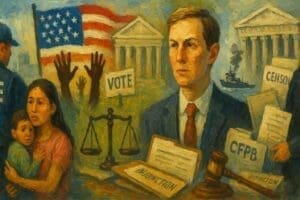
Week 66: Status as Reach
Power widened through immigration enforcement, secrecy, election pressure, and agency hollowing, while courts and oversight slowed but did not reverse the week’s cumulative democratic erosion.
Power widened through immigration enforcement, secrecy, election pressure, and agency hollowing, while courts and oversight slowed but did not reverse the week’s cumulative democratic erosion.
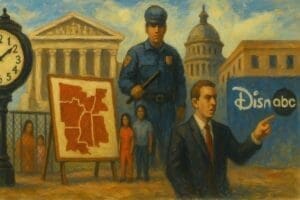
The week’s central movement was conversion: court rulings, prosecutions, budgets, and security fears were turned into tools for narrowing representation, oversight, and neutrality without breaking formal procedure.
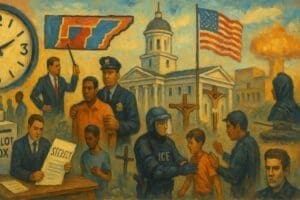
The week’s central movement was consolidation: weakened voting-rights protections, harsher immigration enforcement, retaliatory legal pressure, and war secrecy all thickened existing patterns without moving the clock forward.
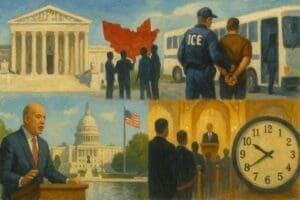
A week of consolidation rather than rupture: voting-rights setbacks were converted into redistricting and election control, agencies were bent toward political ends, and oversight remained active but weak.
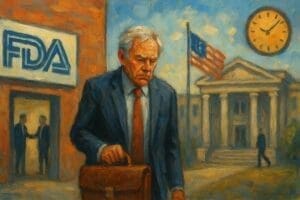
A week of surface calm revealed a deeper pattern: instability at the FDA made expert administration look more contingent on loyalty than competence. The clock did not move, but the record thickened around politicized governance inside the state.
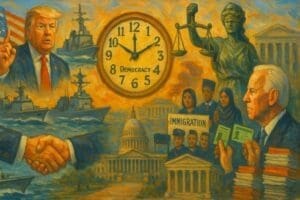
With the clock frozen at 8:13 p.m., Week 65 entrenched emergency war-making, elite-friendly clemency, politicized courts, and donor-driven economics, while fragmented institutions and civil society fought to preserve remaining constraints.
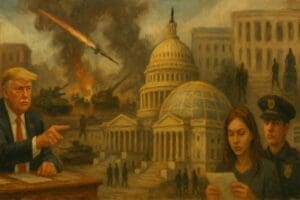
Iran war brinkmanship, SAVE-based voter policing, and Golden Dome patronage entrenched executive and crony power while archives, courts, and surveillance rules bent toward insiders. Courts, cities, and organizers pushed back, but the Democracy Clock’s public time stayed fixed.
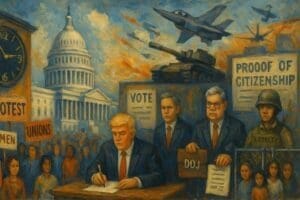
The clock stayed at 8:13 p.m. as Trump moved to federalize elections, stratify citizenship, militarize protest policing, and rewrite history, while courts, litigators, and mass protests mounted reactive but real resistance.
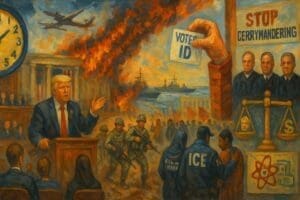
War in Iran, a coercive voter-suppression drive, gutted oversight, and captured regulators advanced together, entrenching executive power and oligarchic influence while formal institutions and elections persisted.
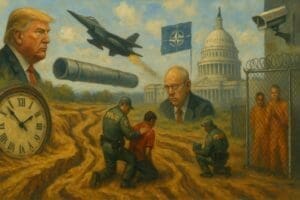
The clock stayed at 8:13 p.m. as war, emergency powers, immigration enforcement, and voting rules were woven into a denser architecture of unchecked executive authority and stratified citizenship, with courts offering limited resistance.