Week 50: Consolidation as Governance
December 27, 2025 - January 2, 2026
Week Sart Time:8:11 p.m.
Week End Time:8:11 p.m.
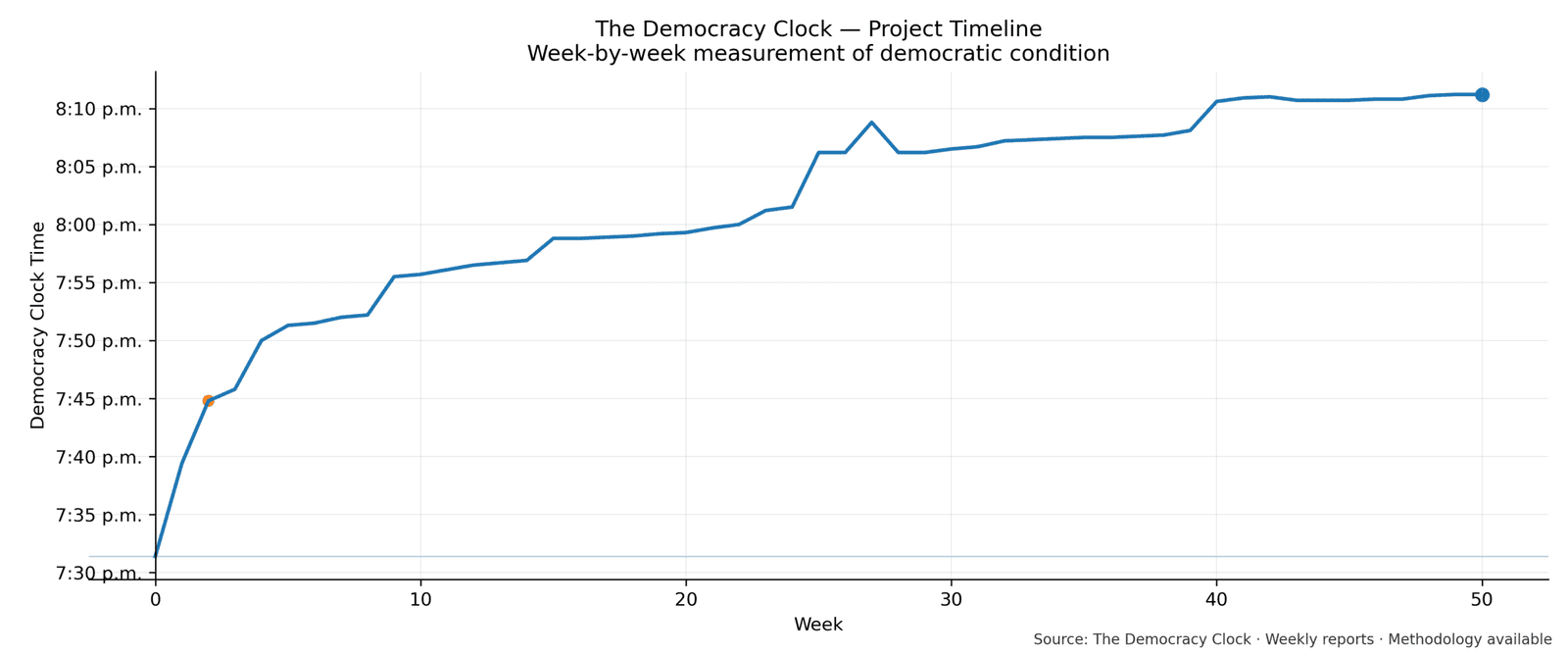
With the clock frozen, the administration deepened its use of law, security, and narrative to personalize power and stratify rights without new formal shocks.
The last week of the year did not bring a single shock. It brought a pattern into sharper focus. Across immigration, security, public spending, and information, the same hand reached for the same tools: law, force, and narrative. Each move could be defended as policy, as management, as necessary response. Together, they showed a government more willing to treat institutions as extensions of one person’s will and one faction’s interests. That was the point.
At the close of Week 49, the Democracy Clock stood at 8:11 p.m. It ended Week 50 at 8:11 p.m. as well, a net change of zero minutes. The stillness in the measure did not mean nothing moved. It meant that the week’s actions deepened patterns already in place rather than opening new ground. Executive power was used more confidently without new formal powers. Law was bent more openly toward friends and against enemies. Security forces and information systems were steered further toward regime priorities. Courts and civil society pushed back in places, but not enough to shift the overall balance.
The most visible consolidation came in immigration. Inside the bureaucracy, the Justice Department and USCIS issued guidance to generate between one hundred and two hundred denaturalization cases each month. What had once been an extraordinary step—stripping citizenship—was recast as a routine target. At the same time, USCIS paused naturalization ceremonies and green-card interviews for nationals of nineteen countries associated with earlier travel bans. The stated rationale was security. The effect was to freeze the legal paths of people defined by origin, not by conduct.
On the ground, these shifts landed in specific lives. Immigration officers deported Moises Sotelo, a vineyard manager in Oregon, tearing him from his family and workplace. Other officers pulled people from cars and courthouse hallways, turning spaces meant for daily life and justice into sites of fear. The FBI sent extra agents to Minnesota to pursue fraud schemes linked to Somali communities, including referrals for denaturalization. Legitimate financial crimes were real, but the focus on one immigrant group blurred the line between targeted enforcement and group stigma. That line matters.
Behind these cases, the infrastructure of coercion grew. ICE moved to expand detention capacity through warehouse-style facilities near logistics hubs, backed by long-term funding. The agency launched a $100 million recruitment campaign for new agents, marketed in “wartime” language and aimed at specific ideological audiences. Immigration enforcement was no longer just a set of cases. It was an industrial system, scaled up and branded as a cause.
At the top, the president claimed personal control over that system. In public remarks, he asserted that immigration enforcement, criminal law, and even forcible renditions were under his direct command. This was not a technical description of chain of command. It was a claim that the coercive powers of the state flowed from his person. The Department of Homeland Security echoed the message in softer form, using a Japanese artist’s work without permission in a social media post that pictured a tranquil America after deportations. The image turned mass removal into a serene ideal, and it did so by appropriating art as state propaganda.
Law followed a similar pattern in the realm of reproductive rights and criminal punishment. A federal appeals court allowed the administration to end Medicaid funding for Planned Parenthood in twenty-two states and the District of Columbia. The decision did not ban care outright, but it cut off reimbursements that sustained clinics serving low-income women. In Kentucky, state police and prosecutors charged Melinda S Spencer with fetal homicide after a self-managed abortion, even though state law did not explicitly criminalize such acts. Prosecutors stretched existing statutes to reach conduct that lawmakers had not clearly forbidden.
These moves came against a backdrop of broader health-policy retrenchment. The administration let enhanced Affordable Care Act tax credits expire after a forty-three-day shutdown, raising insurance costs for millions. At the same time, the Drug Enforcement Administration and Health and Human Services extended pandemic-era telemedicine flexibilities for prescribing controlled substances, the fourth such temporary extension. Emergency tools that had once been justified by crisis now formed part of the normal regulatory landscape. Emergency had become routine.
Courts did not speak with one voice. A federal judge granted a temporary restraining order protecting Imran Ahmed, an anti-disinformation advocate, from detention while his suit proceeded. Another judge dismissed with prejudice an indictment against TikTok streamer Carlitos Ricardo Parias after finding due process violations in an alleged assault on federal agents. Judge Amy Berman Jackson ordered the administration to continue funding the Consumer Financial Protection Bureau despite executive resistance, defending Congress’s design of an independent consumer watchdog. Violent crime and murder rates, meanwhile, continued to fall from their 2021–2022 peaks. The punitive turn in reproductive and immigration law could not be explained as a response to rising crime. It reflected ideological choice.
The president’s use of formal powers against disfavored regions and communities made that choice visible. He vetoed a unanimously passed bipartisan bill to improve drinking water in Colorado, a measure tied to public health rather than partisan policy. He also vetoed a bill funding an Everglades project that would have benefited the Miccosukee Tribe, citing ideological objections. In both cases, the veto power was used not to check overreach but to punish and signal. The targets were clear.
Cultural and public spaces were drawn into the same orbit. The Kennedy Center Board of Trustees changed its bylaws so that only Trump-appointed trustees could vote, and approved a renaming that added the president’s name to the institution. The center is a congressionally chartered arts venue, meant to stand at some distance from day-to-day politics. Concentrating control in one president’s appointees and rebranding the building around him blurred that line. Artists responded by canceling shows in protest, turning their absence into a form of speech.
In Washington, the administration terminated the National Links Trust’s lease to manage public golf courses without a clear successor plan. Workers and local residents were left in limbo as renovations halted. The decision disrupted public recreation and raised questions about whether new, politically connected operators would step in. At the same time, Social Security backlogs swelled past six million cases after budget cuts, delaying benefits for vulnerable people. These were different domains—golf courses and disability claims—but both showed public goods destabilized in ways that could open space for private or insider gain.
Not all uses of public power ran in this direction. New York and Vermont enacted climate superfund laws that required major polluters to fund resilience projects and emissions cuts. These state measures shifted costs onto large emitters rather than onto general taxpayers. They stood as a counterpoint to federal vetoes and rollbacks, illustrating how subnational governments could still use law to protect shared resources. The contrast was stark.
Security forces, at home and abroad, were increasingly framed as tools of political and religious narratives. In major U.S. cities, federal agents appeared in military fatigues with assault rifles to manage protests. The administration pushed to deploy National Guard troops in Democratic-led cities, then withdrew them after court rulings and political pushback. The episodes showed how the threat of military force could be raised and then partially walked back, leaving behind a new normal in which such deployments were thinkable responses to domestic dissent.
Overseas, the pattern continued. U.S. forces carried out strikes in Nigeria and Syria against Islamic State-linked militants, described by officials as a “Christmas present” for the group and tied to protecting Christians. The CIA reportedly conducted a drone strike on a Venezuelan port facility as part of regime-change efforts. The U.S. military attempted to seize the oil tanker Bella 1 en route to Venezuela, only to be thwarted when Russian forces moved to protect the vessel. In parallel, the president threatened military action against Iran over its repression of protests, speaking in personal terms rather than through formal channels.
Real security threats did exist. A federal court held a detention hearing for Brian Cole Jr., a suspect in the January 5 pipe bomb case, weighing his mental health and risk factors before ordering him held pending trial. Law enforcement in North Carolina arrested a radicalized teenager who had planned New Year’s Eve attacks on Jews, Christians, and LGBTQ+ people. These cases showed the state acting to protect targeted minorities and public safety. But they also provided a backdrop against which broader crackdowns on protest and immigration could be justified in the language of security.
Information and memory became contested ground. CBS and 60 Minutes pulled an investigative report on CICOT from broadcast and official archives, even as bootleg copies spread online. The removal showed how a major media outlet could suppress reporting that touched sensitive political terrain. The administration imposed visa bans on European anti-disinformation figures, labeling their work as censorship. The message was clear: those who enforced platform rules or exposed propaganda could be treated as enemies rather than partners.
At the same time, the Justice Department’s handling of Jeffrey Epstein’s records grew more opaque. Advocates accused DOJ of unlawfully limiting release of files through redactions and delays. The department acknowledged that it was reviewing more than five million documents, far more than earlier estimates, and admitted to millions of additional undisclosed records only after congressional pressure. Shifting timelines and numbers deepened mistrust about whether powerful associates were being shielded. The doubt was earned.
The president and his allies filled the resulting space with their own narratives. Fundraising emails disguised as surveys warned supporters about losing tariff rebate checks, steering them into donation funnels built on false premises. The White House shared misleading images of a dead bald eagle beneath wind turbines, using old foreign photos to claim domestic harm from renewable energy. Trump amplified Kremlin narratives by falsely accusing Ukraine of attacking Vladimir Putin’s residence, aligning U.S. discourse with an authoritarian adversary’s propaganda. On trade, the administration celebrated tariffs as a national triumph while quietly implementing carve-outs and delays after exporter lobbying, reducing effective rates on semiconductors, furniture, cabinets, and Italian pasta.
The same logic of selective pressure and protection ran through the justice system’s treatment of elites and ordinary people. Reports surfaced that young spa workers from Mar-a-Lago had been sent to Epstein’s home for sexual exploitation, raising questions about complicity and protection of vulnerable women and minors. Yet the release of Epstein-related documents remained slow and partial. By contrast, the state moved quickly and aggressively against immigrants facing denaturalization quotas and women like Melinda Spencer facing novel homicide charges for self-managed abortion. TROs and dismissals in a few high-profile cases showed that some judges still enforced rights, but the overall pattern pointed toward a two-tier system.
Legislatures and quasi-public bodies became stages for punitive spectacle. The U.S. House of Representatives censured Al Green for interrupting the president during a joint session, punishing floor speech without stripping formal voting rights. It passed a resolution condemning Representative Chuy Garcia’s retirement timing as an attempt to manipulate his successor’s election. In Tennessee, the state House expelled Justin Pearson and Justin Jones for leading a gun policy protest from the floor, using the ultimate sanction against members who challenged the majority on procedure and substance.
The Kennedy Center’s governance change fit the same mold. By restricting voting to Trump-appointed trustees and renaming the institution to include his name, the board turned a national arts venue into a symbol of personal loyalty. In North Carolina, a Select Committee on Oversight and Reform attacked the Chapel Hill School District under the banner of accountability. Republican leaders framed their campaign as necessary reform, even as grassroots groups like Public School Strong organized to defend public education. Oversight became a tool to pressure schools rather than to strengthen them.
The president urged Republican senators to eliminate the filibuster, pressing for a Senate where a bare majority could pass sweeping laws without minority-party leverage. In this context, legislatures functioned less as forums for deliberation and more as arenas where power was displayed and dissent disciplined. Civil society responded where it could. Activists organized public comments opposing policies targeting trans youth. Artists boycotted the renamed Kennedy Center. But the formal rules of representation were being bent toward control.
Economic policy added another layer to the week’s story. The administration implemented large budget cuts to healthcare, science, and anti-hunger programs, weakening public goods that cushion hardship. It allowed expanded Affordable Care Act subsidies to lapse, raising premiums for many. The Social Security Administration, strained by funding cuts, faced severe caseload backlogs that left more than six million claims pending. In North Carolina, lawmakers planned new tax cuts for wealthy individuals and corporations despite budget delays that threatened childcare centers and healthcare providers.
At the same time, organized interests secured relief. After warnings from exporters and foreign governments, the administration delayed higher tariffs on furniture and cabinets and reduced antidumping duties on Italian pasta. Earlier carve-outs had already lowered effective rates on semiconductors and other goods. China responded with a fifty-five percent tariff on U.S. beef and reduced soybean purchases, squeezing American farmers caught in the crossfire. Rising corporate bankruptcies and household financial stress signaled a fragile economy in which risk was pushed downward while those with access to power could negotiate softer landings.
Regulatory agencies moved in ways that often favored industry. The EPA revoked a 2024 rule on reclassifying major pollution sources under the Clean Air Act, restoring a more flexible 2020 standard that industry preferred. It granted a no-migration variance for hazardous waste disposal at a Clean Harbors facility, allowing an exception to land disposal restrictions based on technical findings. Other EPA actions—approving South Carolina’s regional haze plan, revising the Taconite Federal Implementation Plan, and updating information collections—showed the machinery of environmental governance still turning. But the overall direction of high-profile decisions tilted toward deregulation.
Against this backdrop, civil society and subnational actors mounted targeted resistance. In North Carolina, Indivisible and allied activists planned a Long March against racial gerrymandering, a multi-day protest to spotlight Black voter disenfranchisement under the state’s maps. The same network urged support for the Block the Bombs Act, seeking to end U.S. funding for Israeli military actions in Gaza, and mobilized public pressure on the Senate to block unauthorized attacks on Venezuela, invoking Congress’s war powers. These campaigns tried to reassert legislative control over war and foreign policy.
Grassroots groups organized to defend public schools from legislative attacks and to oppose policies targeting trans youth. New York City saw a democratic transfer of local executive power as Zohran Mamdani was sworn in as mayor, opening the door to different urban policies. Federal advisory and statistical processes, such as the EPA’s Local Government Advisory Committee renewal and the Census Bureau’s request to continue questionnaire pretesting, continued to operate, preserving channels for expertise and public input. The exposure of a large Medicaid fraud scheme in Minnesota by federal investigators showed that oversight of public funds still functioned in some domains.
These strands—centralized executive control, weaponized law, militarized security, curated information, economic stratification, and scattered resistance—came together in a week where the formal clock did not move. The absence of numerical change did not signal safety. It marked a period in which earlier shifts were reinforced rather than newly created. Executive authority was exercised with less restraint and more personalization. Institutions that might have checked that authority were pressured, repurposed, or bypassed, even as some judges and state governments held lines.
The moral floor continued to sag under the weight of these choices. Character, in the sense of aligning words with duty, gave way to personal grievance in vetoes and threats. Ethics blurred as public assets and programs were steered toward allies or left to wither. Restraint was scarce in the use of immigration powers, military signaling, and punitive legislative tools. Truthfulness eroded under waves of disinformation and selective disclosure. Good faith and stewardship were strained as transparency laws were tested and long-term capacities—social insurance, public health, civic education—were weakened.
Week 50 thus sits in the record as a week of consolidation rather than rupture. The tools of state power did not change, but their use did. Rights and procedures remained on paper, yet invoking them demanded more persistence and carried greater cost. Civil society and subnational actors showed that democratic energy had not disappeared. They also showed how much of the burden of defense had shifted away from the federal center. The Democracy Clock held its time, not because the danger eased, but because the country had already stepped into this terrain and was now learning how easily it could become the new normal.