Week 72: Courts Push Back, Congress Stirs, and Detention Conditions Boil Over
May 30 - June 5, 2026
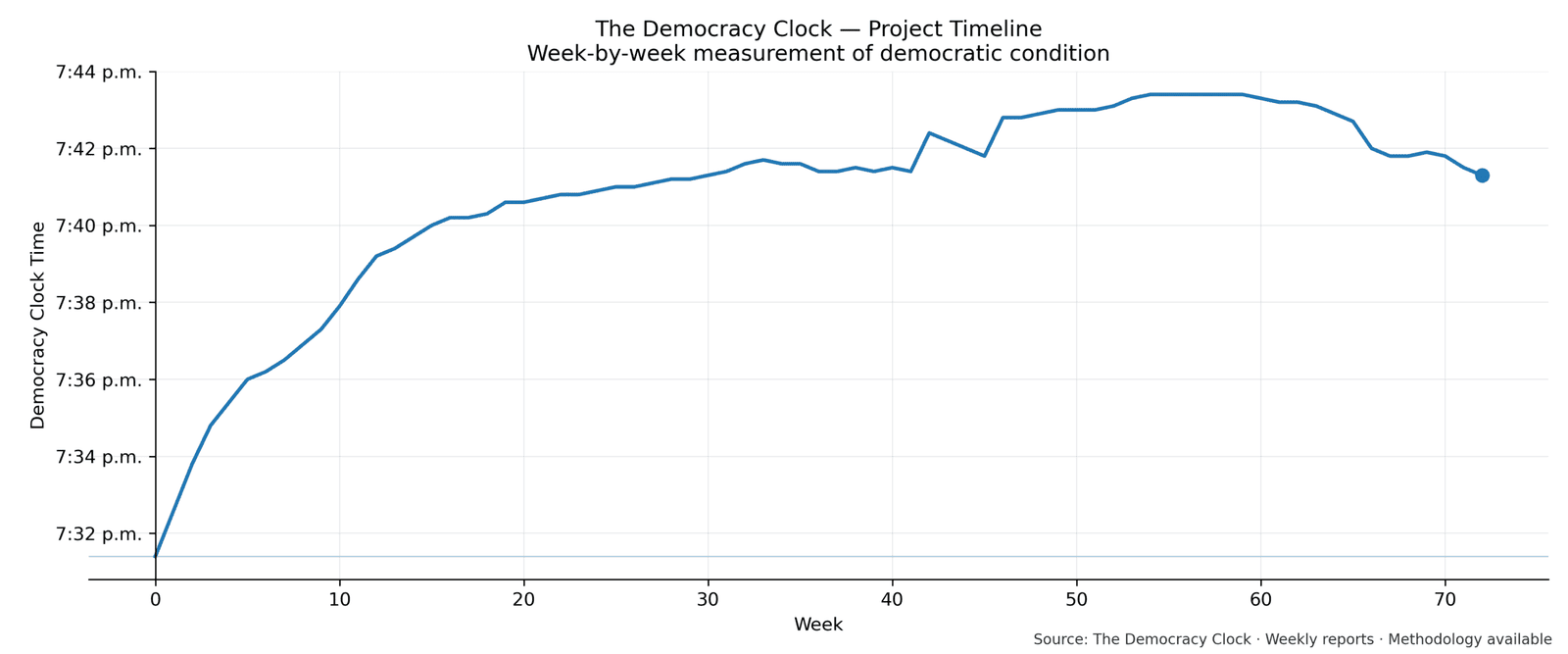
“`markdown This was a week in which the machinery of American government strained visibly against itself — courts checking the executive, Congress intermittently finding its footing, and a crisis in immigrant detention that grew worse by the day even as officials in New Jersey sued to gain access to the facility at its center. By Friday, the pattern was unmistakable: real institutional resistance, but resistance that remained partial, contested, and in several cases reversible.
**The Weekend**
The weekend set the tone. A federal judge ruled that the Kennedy Center could not be renamed without an act of Congress and blocked a planned two-year closure of the institution, prompting an angry, personal social-media attack on the judge from the president. The same stretch of days brought a Miami federal judge’s decision to reopen a $10 billion IRS lawsuit involving Trump personally, after 35 former federal judges alleged the settlement underlying its dismissal was the product of collusion with his own Justice Department; the administration was ordered to respond by June 12 on whether the acting attorney general might need to testify. A three-judge panel that included two Trump appointees unanimously struck down Alabama’s congressional map as intentionally discriminatory against Black voters, a ruling now headed toward Supreme Court review. And the Office of Management and Budget advanced a sweeping proposal — later published as a 400-page Federal Register notice — that would let political appointees cut off federal research grants that don’t serve presidential priorities and would bar diversity and disparate-impact research at universities; MIT was already reporting a 20 percent decline in funding.
It was also over the weekend that the week’s defining crisis began to take shape. Roughly 300 detainees at the Delaney Hall ICE facility in Newark launched a hunger and labor strike over conditions inside the facility. Guards responded with pepper spray. The Department of Homeland Security denied the strike was even happening, and the administration’s border czar threatened force-feeding. By the end of the weekend, New Jersey state police had taken over from ICE at the site and clashed with protesters using tear gas and mounted officers — the first chapter in what would become a week-long standoff. Elsewhere, Trump’s primary endorsement of Ken Paxton over sitting Senator John Cornyn delivered Cornyn’s defeat, a vivid demonstration of the president’s capacity to remove disloyal incumbents from his own party, while investigators revealed that ostensibly progressive super PACs spending heavily in Democratic primaries were secretly tied to House Republican leadership and Speaker Mike Johnson.
**Monday**
Monday brought the week’s most consequential court decisions. The Supreme Court, in a 6–3 ruling, struck down the executive order denying citizenship to children born to undocumented parents, preserving the foundational 14th Amendment guarantee — though dissenting justices lent new credibility to fringe legal theories challenging the doctrine, a signal that the fight is not over. A federal judge separately blocked the administration’s transfer of a national climate research supercomputing center out of Colorado, finding it likely political retaliation, while a federal appeals court ruled the Pentagon’s transgender military ban likely unconstitutional and driven by animus. A Massachusetts judge blocked a Postal Service directive that would have restricted mail-ballot delivery to voters on a federal pre-approved list, protecting access in 23 states and D.C. pending appeal.
Even as courts pushed back, the administration pressed forward on other fronts. The Justice Department filed a 94-page indictment against 15 Minneapolis protesters alleging a sweeping conspiracy against ICE, without charging serious violence, while implicating groups like the AFL-CIO and DSA without formally charging them — a prosecution that read less like a response to specific criminal conduct than an effort to criminalize organizing itself. At Delaney Hall, the crisis sharpened further: ICE officers pepper-sprayed U.S. Senator Andy Kim as he attempted to visit the facility, part of a broader pattern of force against detainees and protesters that week. Reporting also surfaced that more than 100,000 immigration cases had been closed through accelerated "mega-master" hearings with high rates of in-absentia removal, and that the administration was moving to end Temporary Protected Status for more than 330,000 Haitian immigrants. The Pentagon reclassified its press office as a secure facility, requiring journalists to schedule appointments to speak with officials — another increment in a long pattern of tightening access during an active conflict. And after his preferred candidate trailed in California’s gubernatorial primary, Trump ordered the Justice Department to investigate the state’s elections based on unsubstantiated fraud claims.
**Tuesday**
Tuesday centered on money and war powers. Acting Attorney General Todd Blanche told a House panel the Justice Department would abandon the $1.8 billion "anti-weaponization" fund — widely criticized as a vehicle for rewarding Trump allies and January 6 defendants — though he declined to commit the reversal in writing, and the administration preserved a separate IRS audit immunity arrangement. House Republicans moved to formally kill the fund and separately blocked $1 billion in security funding for Trump’s White House ballroom project, both rebukes from within his own party. Speaker Johnson, meanwhile, had sent members home a day early before the holiday specifically to prevent a floor vote on a war-powers resolution concerning Iran — a deliberate maneuver to avoid a constitutional check on war-making. Trump signed an executive order directing the seizure of bank accounts and assets tied to undocumented immigrants, framed as a response to anti-ICE unrest. In New Jersey, state and local officials sued the private operator of Delaney Hall, Geo Group, after being denied health-inspector access to the facility; DHS called the lawsuits frivolous. And Trump explicitly tied federal funding to his endorsement of a California gubernatorial candidate, telling voters that money "will flow" based on his preference — a direct and open form of coercive leverage.
**Wednesday**
Wednesday was arguably the week’s most consequential single day for the structure of federal governance. Trump signed an executive order, paired with a "Schedule Policy/Career" reclassification, stripping adverse-action protections from roughly 8,000 to 10,000 senior federal policy positions, enabling at-will removal of civil servants deemed insufficiently aligned with presidential priorities — a direct threat to the merit-based character of federal administration. Hours later, the House passed a war-powers resolution directing Trump to end hostilities with Iran absent congressional authorization, 215–208, with four Republicans joining Democrats — the first such measure to succeed after months of blocked attempts. The House also advanced a Ukraine aid package providing $8 billion in loans and $300 million in security assistance, 218–204, over leadership’s apparent objections, and the Senate parliamentarian’s ruling forced Senate Republicans to formally strip the ballroom security funding from a reconciliation bill. Trump also signed a sweeping customs enforcement order overhauling importer-of-record regulations and expanding executive authority over trade enforcement. At Delaney Hall, the standoff escalated again: federal agents used force against detainees and protesters, pepper-spraying Senator Kim and demonstrators once more, while the administration’s border czar threatened to send "tactical units" into New Jersey. On a quieter note, Kennedy Center staff began switching signage back to the institution’s original name, the first visible sign of compliance with the court order against its attempted rebranding.
**Thursday**
By Thursday, the House had repassed its war-powers resolution 215–208 and the Ukraine Support Act 226–195, with 18 Republicans defying Speaker Johnson — though a presidential veto remained likely and the measures’ practical force uncertain. The Senate, meanwhile, narrowly rejected an amendment to permanently bar the anti-weaponization fund, 49–50, with three Republicans crossing party lines in support but falling one vote short. A *Washington Post* investigation found that fourteen of 27 known corporate donors to Trump’s $400 million ballroom project had received new or expanded federal contracts worth over $50 billion, including major new Lockheed Martin awards — a pattern suggesting a direct relationship between private donations to a presidential project and the award of lucrative federal business. The human cost of the detention crisis also became starkly visible: a 43-year-old detainee with no criminal record died in ICE custody at a Louisiana facility despite prior federal inspection warnings, the 50th such death under this administration, while separate reporting documented migrant children re-separated from their families despite a binding legal settlement, and ICE rescinded its requirement to report in-custody deaths within 30 days of release. New Jersey’s governor announced a $12 million increase in funding for immigrants’ legal defense, a remedial response to mounting public pressure. Elsewhere, U.S. crude and strategic petroleum reserves fell to their lowest levels in roughly two decades as the administration drew down reserves to offset Iran-war-driven price spikes, and the administration began dismantling a $368 million deep-ocean climate observation system.
**Friday**
The week closed with the Senate’s passage, 52–47, of a $70 billion immigration enforcement package funding ICE and Border Patrol through the end of the president’s term — achieved through budget reconciliation specifically to bypass a filibuster, and containing no guardrails on the anti-weaponization fund whose future had seemed uncertain just days earlier. Trump signed a national security memorandum directing rapid adoption of artificial intelligence across military and intelligence operations, establishing new computing infrastructure with limited specified independent oversight. Courts delivered more rebukes: a federal judge issued a 135-page ruling striking down an immigration freeze affecting 39 countries as driven by unlawful animus and ordered the administration to restart halted asylum processing. Yet the detention crisis showed no sign of resolution — detainees at a Florida facility reported guards withholding food and water to coerce signatures on documents they could not read, children at a Texas facility were served food containing live worms and mold, and ICE formally rescinded its 30-day death-reporting requirement. The Justice Department sent a federal prosecutor to observe ballot processing in Los Angeles County as Trump continued pressing unsubstantiated fraud claims about the California primary. And in an unusual breach of diplomatic norms, the State Department and Vice President JD Vance invoked a British murder case to promote messaging about "civilizational decline," intervening directly in an allied nation’s domestic politics.
Taken as a whole, the week illustrated both the resilience and the fragility of institutional checks under sustained pressure. Courts intervened repeatedly and substantively — on birthright citizenship, climate research retaliation, transgender service members, mail ballots, and an immigration freeze — yet the administration continued to contest whether judicial review should apply to some of its actions at all. Congress found rare bipartisan footing on war powers and briefly forced the retreat of a widely criticized spending fund, but could not convert either into a durable, veto-proof outcome. And at Delaney Hall, the clash between detainees seeking basic humane treatment and state and federal authorities deploying force against them, even as elected officials tried to assert oversight, stood as the week’s starkest reminder that institutional pushback, however real, has not yet been enough to stop documented harm from accumulating on the ground. “`