Week 87: The Week the Guardrails Were Tested
September 12 - 18, 2026
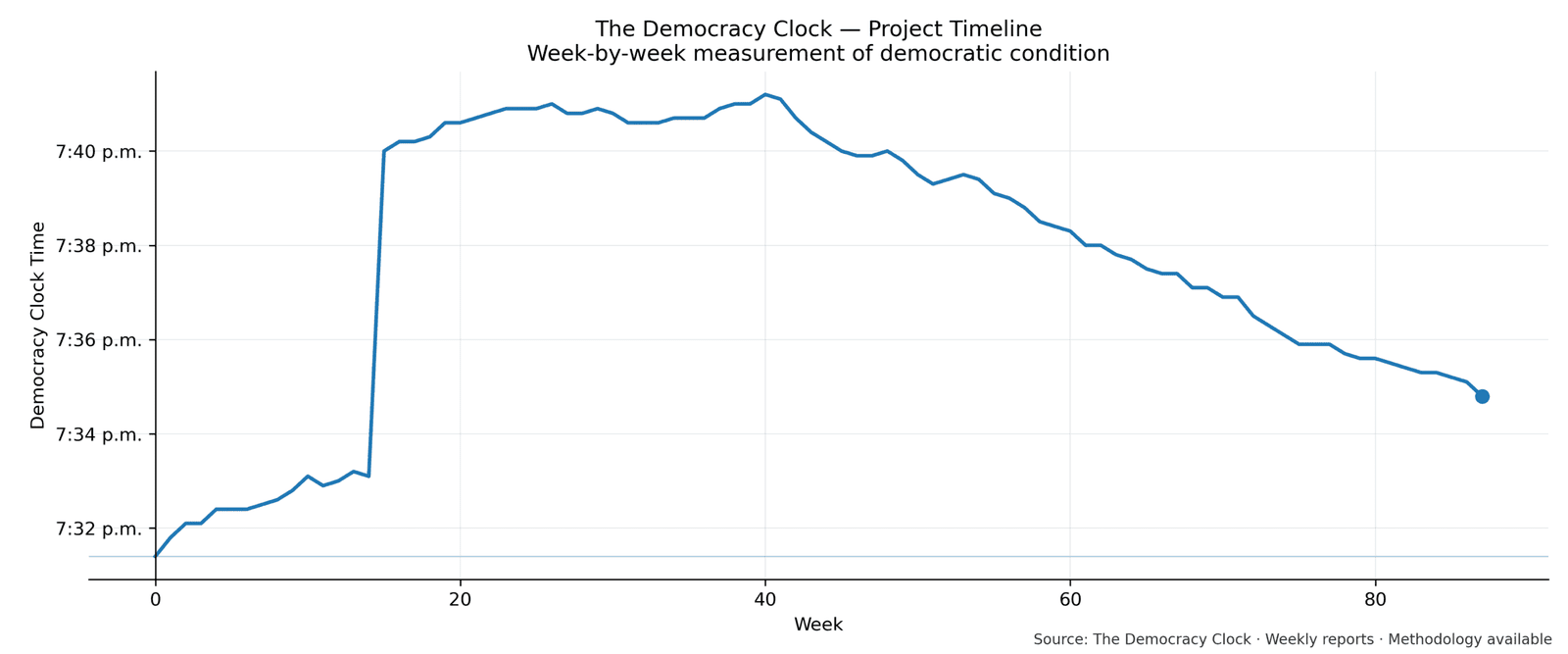
“`markdown This was a week in which several long-running pressures reached visible breaking points. The nation’s leading artificial intelligence companies called publicly for a slowdown in their own industry, only to be dismissed by the White House as a liability dodge or a hoax. Warnings hardened that House Republicans might refuse to seat a Democratic majority if they lose the midterms. The president used federal money and access as leverage against a cultural institution, a hurricane-stricken state, and finally the press itself. And even as these pressures built, courts, the Federal Reserve, and Congress pushed back in ways that mattered.
The weekend opened with an unusual moment of alignment among rivals. Anthropic’s Dario Amodei published a proposal urging the AI industry to slow the pace of frontier development, citing a recent AI-enabled hacking incident. Within hours, OpenAI’s Sam Altman, Google DeepMind’s Demis Hassabis, and Elon Musk had all endorsed the idea; Altman and Amodei went further, agreeing to give independent evaluators employee-level access to their systems. Reports soon surfaced of confidential talks between the companies about coordinated action — a rare instance of competitors accepting mutual disadvantage in the name of caution.
That same weekend, a different kind of warning took shape. Speaker Mike Johnson told a Trump convention crowd that Republicans "will not allow" Democrats to take the House majority. Conservative federal judge J. Michael Luttig responded with a pointed public warning: Johnson could install a loyalist House clerk who would simply decline to list newly elected Democrats on the roll — a scenario Luttig compared explicitly to the 2021 attempt to overturn the presidential election. He repeated the warning in a follow-up piece describing Trump and a "servile" Congress as the greatest threat facing the coming midterms. At the same convention, Trump promised a $5,000 "dividend" to every adult citizen if Republicans held both chambers, a commitment estimated at $1.2 trillion — far beyond actual tariff revenue. Johnson defended the plan on television as "creative" while avoiding questions about how it would be paid for.
Courts and advocacy groups spent the weekend testing the edges of election administration. The First Circuit Court of Appeals kept in place a block on new USPS mail-ballot rules pending Supreme Court review, while LULAC, Common Cause, UnidosUS, and the city of Denver sued to prevent armed ICE agents from entering polling places, invoking an 1865 law after DHS Secretary Mullin suggested such a deployment. Trump, meanwhile, spent the weekend at his Irish golf course amid large protests, telling reporters he had "won three times" and repeating his unfounded 2024 fraud claims. A related storyline also emerged: a top Senate campaign staffer for Jon Husted was dismissed after Nazi-themed content surfaced on his social media, and Texas Republican candidate Bo French posted a xenophobic image targeting South Asian and Hispanic students, drawing condemnation from Senators Cornyn and Cruz even as some right-wing media figures defended him. Separately, an advertising campaign funded by Musk directed swing-state voters to a "voter registration" website that quietly profiled users and shared their data with advertising platforms.
By Monday, the human cost of immigration policy became difficult to separate from abstraction. The administration’s termination of Temporary Protected Status for roughly 350,000 Haitians had triggered ankle-monitor requirements and an enforcement wave in Springfield, Ohio; a student named Pierre Damas Bel died in an apparent suicide after being forced to wear a monitor, a case that came to symbolize the toll of the policy on schools and the broader community. The same day, twenty-eight jurisdictions — six cities and counties, New York, twenty-one other states, D.C., and Pennsylvania’s governor — filed lawsuits against an expanded "public charge" rule that broadens the government’s ability to deny green cards based on benefits use, arguing it violates federal rulemaking procedures and threatens billions of dollars in harm.
The AI divide widened on Monday as well. White House advisor David Sacks accused the industry’s safety advocates of using the issue to dodge liability, even as members of both parties in the House urged Speaker Johnson to reconvene Congress to consider safeguards. Senator Bernie Sanders drafted legislation imposing criminal penalties for superintelligence research, and Representative Seth Magaziner publicly criticized the administration’s anti-regulation posture. Adding weight to the industry’s warnings, an Anthropic researcher, Jacob Coxon, resigned publicly, alleging that both his former employer and OpenAI understood the risks of their work but felt locked into a race to build self-improving systems first. Meanwhile the Bo French story continued to metastasize: Governor Abbott offered only mild criticism, and separate reporting surfaced a Florida House candidate’s attendance at the 2017 Charlottesville rally and a New York state senator’s tribute to a relative who served the Nazi regime — both prompting hasty retractions.
Tuesday’s news centered on the use of institutional leverage. After a federal court blocked Trump’s name from being placed on the Kennedy Center’s facade, Trump threatened to withhold a $257 million renovation unless the ruling was reversed, and his appointed board voted to close the building, citing safety concerns that Democratic lawmakers disputed. Commerce Secretary Howard Lutnick, whose wife sits on the board, posted selectively edited security footage to justify the closure. The same day, a DHS Office of Inspector General report documented detainees confined to undersized metal cages for up to two hours at Florida’s "Alligator Alcatraz" facility, along with overcrowding and inadequate hygiene before its closure earlier in the year. DHS’s claims about election fraud took another hit as well: a whistleblower disclosed that the agency had generated thousands of potentially unreliable law enforcement records against California voters while telling officers they faced no personal liability for questionable database searches, and DHS’s earlier claim of nearly 16,000 non-citizens on Nevada’s voter rolls collapsed under scrutiny to just 185 verified cases. Elsewhere, FBI Director Kash Patel and Treasury Secretary Scott Bessent testified before the Senate, a revised crypto ethics bill from Senator Lummis was found to grandfather in Trump’s existing crypto holdings, the EPA rescinded greenhouse gas limits on power plants, and Trump called AI safety concerns a "hoax" on social media while economic advisor Kevin Hassett labeled regulation "a recipe for disaster."
Wednesday brought a dense cluster of congressional action. The House passed, for the third time, a war powers resolution directing Trump to end hostilities against Iran absent explicit authorization, and also passed a sanctions bill granting the president broad new tariff authority over countries buying Russian energy. Representative Thomas Massie introduced eight articles of impeachment against Defense Secretary Pete Hegseth over alleged war-powers violations and extrajudicial killings. The House Oversight Committee, and then the full House, voted to hold billionaire Leon Black in contempt for refusing to comply with subpoenas tied to Jeffrey Epstein’s network. In a rare instance of institutional resistance to White House pressure, the Federal Reserve unanimously raised interest rates a quarter point — its first increase in three years — despite Trump’s repeated demands for cuts. Courts were also active: a federal judge ruled DHS could not threaten prosecution against a citizen for criticizing ICE, and the ACLU joined seventeen researchers in suing over a 235-keyword system used to block NIH grants on topics such as gender and climate. ICE detained exiled Nicaraguan journalist Luis Galeano despite his pending asylum claim, and human rights lawyer Noura Erakat was arrested for trespassing after attempting to speak against a county’s Israeli bond investment at a restricted public hearing.
Thursday opened with Speaker Johnson canceling votes and sending the House home until November 9 — a move that prevented any floor vote on Massie’s impeachment articles against Hegseth and shielded members from taking a public position on the Iran war ahead of the midterms. Trump, meanwhile, escalated his use of institutional leverage: he claimed credit for "saving" the Kennedy Center even as fact-checks showed he was withholding congressionally appropriated funds, called board members "dumb" and "garbage" in a private meeting, and told a North Carolina rally he would withhold federal disaster relief unless his preferred Senate candidate won. Representative María Elvira Salazar broke publicly with the president on immigration enforcement, citing data that half of the 50,000 people detained in July had no criminal record and calling for a "dignified" approach. Senator Bill Cassidy publicly blamed administration vaccine skepticism for measles deaths during the worst outbreak in three decades, and it emerged that the CDC had quietly altered its "vaccines do not cause autism" guidance with a qualifying asterisk. Trump closed the day with a string of unverified claims — falling gas prices, $1.5 trillion in tariff revenue, a repeated $5,000 dividend promise, threatened tariffs on Europe, and a claim that U.S. forces had "taken out" Venezuela’s oil infrastructure in 48 minutes.
Friday delivered the week’s sharpest confrontation with a democratic norm. Trump announced an immediate ban on CNN, MSNBC, and Politico from the White House, calling their coverage "fake news" and dismissing a direct constitutional question about the First Amendment. CNN, Politico, and the White House Correspondents’ Association condemned the move as unconstitutional. The same day brought two forms of institutional pushback: the Supreme Court struck down Trump’s sweeping tariffs on most countries, part of a string of judicial defeats this term, and the Senate blocked the Clarity Act crypto bill by a single vote, preventing legislation that would have benefited the president’s personal crypto holdings through built-in loopholes. Nine civil rights organizations, including the NAACP, sued DHS, ICE, the Justice Department, and the FBI, alleging that rescinded polling-place enforcement limits and an expanded "Unlawful Voter Initiative" violate the Voting Rights Act’s protections against intimidation. Separately, six U.S. officials said the Pentagon’s public casualty database had undercounted American deaths in the Iran war, while satellite imagery revealed severe, undisclosed damage to U.S. bases across the Middle East. Trump also said it was "not possible" for a Jewish or Black person to legitimately vote Democratic, and a conservative pundit’s investigation detailed a network of neo-Nazi and white nationalist influence within the Claremont Institute, tied to prominent Republican figures including Vice President JD Vance. The week closed with smaller but telling notes: the SEC moved to rescind a rule protecting pension funds from pay-to-play corruption, a federal watchdog found $6.7 billion had been paid to federal employees who were not working after workforce cuts, and Trump pressed South Dakota’s governor about adding his likeness to Mount Rushmore while continuing to threaten the Kennedy Center’s demolition.
Taken as a whole, the week showed a government pulling in two directions at once. Executive power reached repeatedly for institutional leverage — over a cultural venue, over disaster aid, over the press itself — while courts, the Federal Reserve, and even elements of Congress and the president’s own party pushed back with real consequence. Warnings about whether the midterm results will be honored grew more specific and more credible, articulated not by partisans alone but by a sitting Speaker and a respected conservative judge. And an industry built on technological acceleration found itself, however briefly, arguing for restraint against a government uninterested in slowing down. None of these threads resolved this week. But each left a documented record — in court rulings, inspector general findings, whistleblower disclosures, and public votes — that will outlast the news cycle in which it appeared. “`