Week 85: Lake America, War Powers, and the Mail-In Ballot Fight
August 29 - September 4, 2026
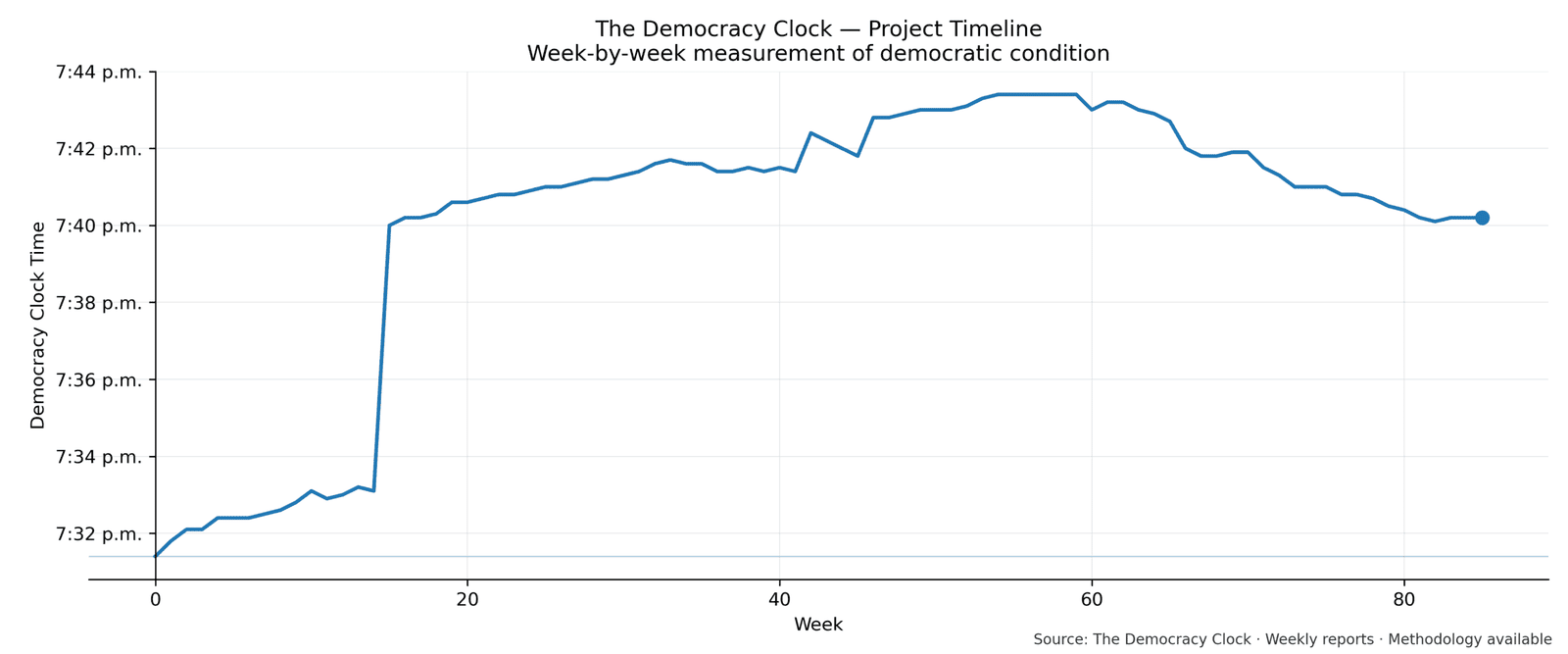
“`markdown This was a week in which the machinery of government moved on several fronts at once, and the pattern connecting them grew clearer by Friday than it had been on Saturday. A presidential order over a lake’s name, a fight over how mail-in ballots get verified, continued strikes near the Strait of Hormuz, and a string of court rulings on executive power all unfolded alongside each other — each testing, in its own way, how far current officeholders could extend their reach before courts, Congress, or public pressure pushed back.
The weekend began with a gesture that looked almost trivial: an executive order directing federal agencies to rename Lake Ontario "Lake America." Google complied for U.S. users almost immediately; Canada’s government rejected the change outright, noting the lake’s Indigenous name and origins. The episode landed inside an already-tense trade relationship over steel tariffs, and it set a tone that would recur throughout the week — a willingness to use presidential authority to reach into private platforms and international relationships over matters with little practical stakes but real symbolic weight. Apple’s later compliance with the same renaming effort, after direct outreach from the president, extended the pattern into the following week.
Alongside the lake dispute, the Department of Homeland Security was revealed to be using an obscure customs statute to obtain phone, financial, and social-media records on journalists, unions, and nonprofit groups — bypassing a judge who had twice rejected warrant requests in similar cases for lack of probable cause. The maneuver would resurface days later when Senator Ron Wyden and Representative Pramila Jayapal formally requested a GAO investigation into the practice, arguing it circumvented judicial oversight entirely. Over the same two days, ICE deported commentator Milo Yiannopoulos within 24 hours of his arrest for a visa overstay — a pace well outside the norm that raised questions about whether enforcement speed tracks political notoriety. A Pentagon-brokered deal granting the United States majority control over Venezuelan oil reserves, arranged through a politically connected private operator despite constitutional restrictions in Venezuela on private oil ownership, suggested that resource diplomacy was increasingly running through military channels rather than the State Department. The weekend closed with a notable intra-party result: Florida Democrats nominated DSA-backed Angie Nixon over establishment favorite Alex Vindman, a signal of the pressures building within the party ahead of the midterms.
By Monday, the courts were active on multiple fronts. The Supreme Court, in a 5–4 decision, allowed construction of a $400 million White House ballroom to proceed, ruling that the National Trust for Historic Preservation lacked standing to challenge it — a decision that left the underlying legality of the project unresolved even as Chief Justice Roberts, in dissent, warned it likely violated federal law requiring congressional authorization for such construction. That same day, federal judge Indira Talwani blocked a new 95-page Postal Service rule imposing fresh verification requirements on mail ballots, finding the government had not produced evidence of fraud sufficient to justify the change. The ruling mattered immediately: a whistleblower had separately told Senator Richard Blumenthal that the rushed verification system could reject entire batches of up to 10,000 ballots over a single scanning error, raising the uncomfortable question of whether the flaw was accidental or intentional. Monday also brought word that the Pentagon had quietly hired retired colonels and social-media personalities as government employees to amplify Defense Secretary Pete Hegseth’s messaging, and that a federal judge had struck down New York’s climate superfund law, siding with oil companies and the Justice Department against a $75 billion damages requirement passed by the state legislature. DHS, meanwhile, redirected immigration officers to scrutinize voter rolls after claiming — without verified data — that nearly 250,000 noncitizens were registered across four states. Trump closed the day by calling for FCC action against NBC over poll coverage and declining to rule out nuclear weapons against Iran when asked directly by a reporter.
Tuesday opened with the House passing a continuing resolution through December 11, averting a shutdown with a wide bipartisan margin, even as two Democrats — Jared Golden and Marie Gluesenkamp Perez — drew sharp rebukes from their own leadership for joining Republicans on a procedural vote. The day’s larger story, though, was military: Trump ordered new airstrikes on Iranian targets near the Strait of Hormuz, warning of harsher retaliation if Iran responded, as reports surfaced of civilian casualties, including a wedding struck in Hormozgan province. The Pentagon’s internal troubles deepened in parallel: Hegseth restricted press access to the building, and three Stars and Stripes journalists were fired after critical coverage of shipboard conditions, prompting a First Amendment lawsuit. House Democrats responded by calling for Hegseth’s impeachment, citing corruption allegations, troop mistreatment, and the unauthorized nature of the ongoing strikes. The day’s most direct warning for the coming election came from Homeland Security Secretary Markwayne Mullin, who declined to rule out ICE presence at polling places despite federal law barring armed agents from election sites. Massachusetts held its Senate primary, with Ed Markey leading Seth Moulton. And a joint report from Human Rights Watch and Physicians for Human Rights documented 52 deaths in ICE custody in under eighteen months — nearly four times the rate under the previous administration, with inadequate medical care suspected in most cases.
Wednesday carried the election-administration story further. Homeland Security Investigations formally launched a nine-state voter-fraud surge, directing agents to pursue leads through mid-October — pulling immigration enforcement personnel directly into election oversight weeks before voting began. The Justice Department issued a new legal opinion reversing a Clinton-era interpretation, now requiring any state receiving TANF or SSI funds to report undocumented immigrants across its entire government rather than just the administering agency, a change with clear implications for mixed-status families. Congressional Democrats formally requested that the GAO probe DHS’s surveillance of journalists and unions. Separately, Epstein survivors publicly pressed billionaire Leon Black to comply with House oversight subpoenas ahead of a scheduled deposition, while federal courts rejected two administration positions — dismissing a DOJ lawsuit against California’s trans-inclusive school sports policy for inadequate notice, and facing a new suit from Patagonia and conservation groups over reductions to Bears Ears and Grand Staircase-Escalante. The U.S. Mint, meanwhile, began selling dollar coins bearing Trump’s likeness, marketed as "gold" despite being made of base metals.
Thursday was the week’s busiest day for consequential rulings. Federal judge Deborah Boardman blocked the administration’s second attempt to narrow birthright citizenship, ruling flatly that no executive order can override existing Supreme Court precedent. The mail-ballot fight reached a new stage of urgency: Judge Talwani questioned the constitutionality of extending her earlier block at a hearing, even as Solicitor General John Sauer simultaneously petitioned the Supreme Court to enforce the very same restrictions — setting up a direct confrontation over who controls ballot rules weeks before voting. Leon Black failed to appear for his scheduled deposition, instead suing to challenge the House Oversight Committee’s authority; Chairman James Comer declined to immediately pursue contempt. Senator Thom Tillis became the most prominent Republican to break publicly with the administration, calling Hegseth’s management the worst he had witnessed and urging his removal over culture-war distractions from readiness problems. Interior Secretary Doug Burgum announced construction of a 250-foot triumphal arch between the Lincoln Memorial and Arlington National Cemetery, again without the congressional authorization required by the 1986 Commemorative Works Act — an echo of the ballroom project days earlier. Separately, the Justice Department blocked civil rights prosecutors from charging an ICE officer who shot a Venezuelan man in Minneapolis, and Texas Governor Greg Abbott refused to sign an extradition warrant Minnesota sought in the case. Representative Suhas Subramanyam disclosed that the DOJ had wiretapped his phone calls, calling it part of a pattern of surveillance against the president’s political opponents. Steve Bannon publicly announced that ICE agents would "surround the polls" in November, amplifying Mullin’s earlier comments into an explicit threat. The House passed legislation conditioning federal student aid on universities certifying they do not participate in boycotts of Israel, with 33 Democrats joining Republicans, while Speaker Mike Johnson canceled all House votes for the final two weeks of September. Oil and diesel prices, meanwhile, climbed for a fourth straight session as the Navy blockaded Iranian exports and two tankers were attacked near Oman — a tangible domestic cost of the still-unresolved conflict.
Friday closed the week with the mail-ballot dispute arriving formally at the Supreme Court, as the administration pressed justices to revive the USPS rules a lower court had blocked; Justice Ketanji Brown Jackson set a September 8 deadline for responses, even as the system’s own implementation portal remained non-functional. New EOIR training instructed immigration judges to sharply limit continuances — the legal delays that let immigrants secure counsel — with reporting showing the policy applied even to abused children and crime survivors. That policy’s human cost appeared in the same day’s reporting: a five-year-old child and his father were deported to Mexico without apparent judicial review, part of a broader pattern of people flown in shackles to countries they had never visited. Separate investigations revealed that a Florida police department had shared license-plate data with 365 agencies nationwide, that opioid settlement funds had been diverted to purchase surveillance cameras, and that a surveillance vendor had demonstrated protest-monitoring capability to police using footage from an actual demonstration. The administration’s deadline to compile citizenship data for state election officials arrived despite the effort having lost 23 consecutive legal challenges over its reliability. The Commerce Department quietly removed language barring political interference from Census Bureau reports, ahead of the 2030 count. An inspector general report detailed misconduct allegations against former Labor Secretary Lori Chavez-DeRemer, based on testimony from 38 witnesses — one of the week’s few instances of an internal watchdog process working as intended. The Supreme Court otherwise closed out a quiet docket with routine denials and procedural orders.
Taken as a whole, the week showed a government pulling in two directions at once. Courts in Massachusetts, Maryland, and elsewhere repeatedly blocked specific executive actions — on mail ballots, on birthright citizenship, on climate liability, on trans-inclusive school policy — while the administration just as consistently pressed forward through appeals, new rules, or quiet reassignments of federal personnel. The cumulative effect on election administration was the week’s most serious throughline: a verification system a whistleblower warned could silently discard thousands of ballots, immigration agents redirected toward voter rolls, a nine-state fraud surge timed to the midterms, and public statements from a cabinet secretary and a prominent political operative both raising the prospect of armed federal presence at polling places. None of these actions, individually, decided an election. Together, they described a system under sustained pressure from the agencies meant to administer it fairly, checked only by judges, whistleblowers, and a press corps that was itself facing surveillance, firings, and restricted access even as it reported the story. “`