Week 62: Emergency As Standing Policy
March 21 - 27, 2026
Week Sart Time:8:13 p.m.
Week End Time:8:13 p.m.
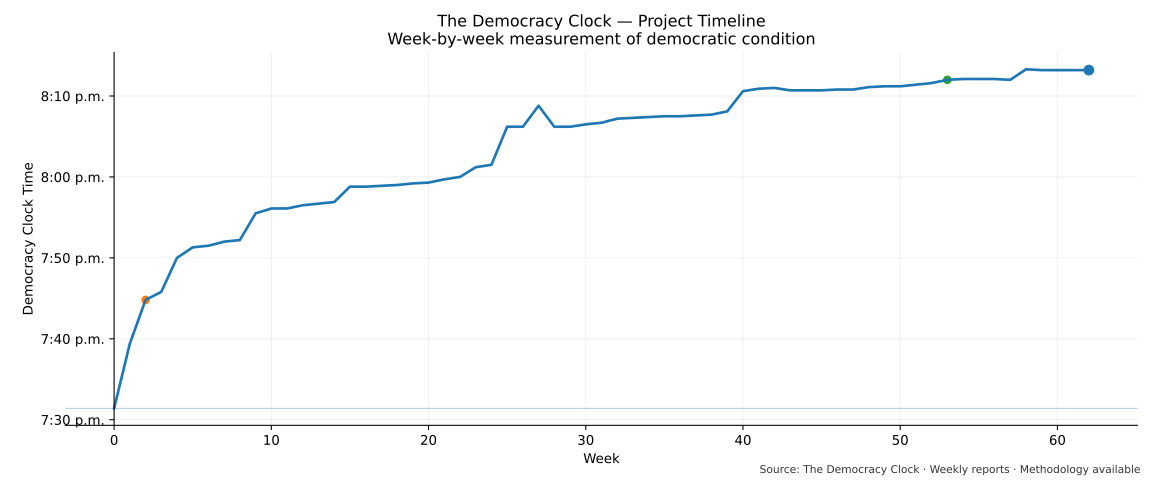
War in Iran, a weaponized shutdown at home, and a coordinated squeeze on voting and citizenship turned crisis into the default mode of governance.
The sixty-second week of Trump’s second term unfolded as a study in layered strain rather than a single break. War abroad, shutdown at home, and a grinding fight over who counts as a voter and a citizen all moved forward at once. Each domain had its own logic and actors, yet together they described a government that treated crisis as a standing condition and used it to redraw the lines of power. The pattern was not new. What changed was the confidence with which it was applied and the breadth of systems it now touched.
At the close of the previous period, the Democracy Clock stood at 8:13 p.m. By the end of this week, it remained at 8:13 p.m., a net change of zero minutes. The stillness in the measure did not reflect calm. It reflected offsetting forces: deepening unilateral war-making, voter restriction, and stratified citizenship on one side, and pockets of institutional and civic resistance on the other. The balance held, but only because courts, states, and civil society absorbed more strain to counter moves that, left unchecked, would have pushed the clock forward.
The week’s central axis was the Iran war, now plainly an executive project. Early in the period, reports surfaced that the administration had weighed an assault on Iran’s Kharg Island and prepared thousands of Marines for deployment. These were not contingency plans in a distant file. They were active options, readied by the Pentagon under presidential direction. Trump then publicly threatened to “obliterate” Iranian power plants if the Strait of Hormuz was not reopened, signaling a willingness to target civilian infrastructure in service of coercive aims. The language was blunt. The chain of authority was short.
As the days passed, the president announced and then extended pauses of planned bombing campaigns, claiming negotiations with Tehran that Iranian officials denied. Each pause and claimed breakthrough moved markets and shaped public expectations, yet none passed through the formal channels that usually accompany war and peace. Behind the announcements, the Pentagon deployed and prepared to deploy large Army and Marine units to the region, deepening U.S. entanglement without new authorization. By week’s end, Trump described the Iran campaign as a “military operation” and a success, even as he acknowledged that Congress had not approved it. Hostilities of that scale were treated as a matter of presidential discretion.
Foreign influence threaded through these decisions. Saudi Crown Prince Mohammed bin Salman lobbied Trump to continue and expand the war, pressing for strikes that looked less like self-defense and more like regime change. Israeli leaders also urged escalation. At the same time, Saudi funds flowed into Jared Kushner’s investment firm and a Trump-branded development, tying the president’s family finances to a monarchy with a direct stake in Iran’s fate. When Trump launched strikes on Iran at the urging of these leaders, without an imminent threat finding, it underscored how personal relationships and foreign interests could shape U.S. war decisions more than institutional checks.
Congress appeared in this story mostly as a frustrated observer. Republican leaders refused to hold hearings that might scrutinize the war’s justification, choosing instead to back the president and avoid public oversight. Senate Democrats tried to require congressional authorization for continued operations, but their efforts failed. Members in both chambers sought more detailed briefings on strategy, costs, and objectives, only to receive vague presentations that left nearly $30 billion in war spending and major shifts in alliance priorities largely unexplained. The constitutional allocation of war powers remained on paper. In practice, the presidency acted first and informed later, if at all.
The conflict in the Gulf was not only a military affair. It became an economic shock tool. Iran closed the Strait of Hormuz and imposed tolls on ships, disrupting a key route for global oil and liquefied natural gas. Iraq declared force majeure on foreign-operated oilfields, unable to fulfill contracts because exports could not move. Fuel shortages and price spikes rippled outward. In parts of Asia, governments ordered work-from-home arrangements, shortened workweeks, and early university closures to conserve fuel. A distant strait became a lever on daily life for millions.
The Trump administration responded by easing sanctions in ways that blended war policy with market management. Treasury and the White House lifted or waived sanctions on roughly 140 million barrels of Iranian oil already at sea, allowing it to reach market to lower prices even as U.S. forces fought Iranian targets. Sanctions on Belarus were relaxed to secure fertilizer imports, trading away human-rights leverage for short-term economic relief. At home, the U.S. Postal Service prepared an eight percent fuel surcharge on packages, passing war-driven costs to households and small businesses. The executive branch thus used sanctions relief and emergency surcharges to manage the fallout, with little visible legislative input, while the burdens of geopolitical risk settled on ordinary people.
If war abroad showed one face of emergency governance, the prolonged shutdown of the Department of Homeland Security showed another. For weeks, Congress failed to agree on DHS funding. Seven Senate votes collapsed amid disputes over immigration enforcement and voting provisions. A Senate-passed package that omitted ICE funding stalled when House Republicans refused to take it up, preferring alternative plans that preserved leverage. The result was a partially unfunded security department, unpaid workers, and mounting operational strain.
Into that vacuum stepped the president and his preferred enforcement arm. Trump threatened to deploy Immigration and Customs Enforcement agents to airports to backfill unpaid Transportation Security Administration staff, then followed through. ICE officers in tactical gear appeared in civilian terminals, performing screening functions that had long been the domain of specialized, non-immigration personnel. The move turned immigration enforcement into a visible political tool in everyday public space, blurring the line between border policing and routine security to pressure Congress. Hearings in the House documented the human cost: TSA workers struggling without pay, ICE transfers to airports, and poor conditions in detention centers. The stories were concrete. The strain was visible.
As the shutdown dragged on, Trump issued an executive order directing DHS to pay TSA agents despite the funding lapse. The order relieved immediate hardship but did so by improvising around appropriations rules, reinforcing the idea that the president could patch over legislative failure with ad hoc decrees. At the same time, the Senate confirmed a loyal Trump ally, Markwayne Mullin, as Secretary of Homeland Security, placing a political confidant atop a vast security bureaucracy in the midst of a shutdown and immigration crackdown. Civil service roles that had once rested on professional norms were now shaped by partisan loyalty and emergency workarounds.
The fight over who would be screened at airports and who would be paid for it ran parallel to a broader campaign over who would be allowed to vote. Trump and his allies pushed the SAVE America Act, which tied DHS funding to strict proof-of-citizenship requirements and new voter ID rules. Senate Republicans explored using budget reconciliation to finance ICE and embed SAVE provisions, a way to bypass the filibuster and enact contentious voting changes with a bare majority. Trump publicly urged elimination of the filibuster to speed this agenda, framing it as necessary to secure the border and elections. The linkage was explicit. The stakes were high.
In the courts, the Republican National Committee pursued its own flank. It filed a lawsuit seeking stricter verification and counting rules for mail ballots, aiming to make it harder for such votes to be included. The Supreme Court agreed to review a challenge to Mississippi’s deadline for counting mail-in ballots that arrive after election day, a case with implications for close races and voter confidence. At the local level, a county sheriff in California seized and initiated recounts of more than 650,000 ballots from a prior election based on disputed fraud claims, blurring law-enforcement and electoral roles and risking public trust in neutral administration.
The executive branch prepared to go further still. Trump called for “nationalizing” aspects of voting, challenging the long-standing state-led structure of U.S. elections. A draft executive order under consideration would end machine and mail voting, require all voters to re-register with proof of citizenship, and mandate hand counts. Such an order would centralize sweeping changes to election rules in the presidency, bypassing legislatures and state officials. Civil-society groups like Democracy Docket tracked these moves and the related litigation, providing analysis that made the pattern visible: under the banner of “integrity,” the system was being reengineered to narrow the electorate and shift control of election machinery toward the executive and a partisan majority.
Immigration policy was another arena where lines between law, enforcement, and rights were redrawn. ICE and DHS expanded aggressive operations, including high-profile arrests at airports and intensified crackdowns in Minnesota. A legally documented Canadian mother and her child were detained in harsh conditions and pressured to self-deport. New rules tightened commercial driver’s license requirements for immigrants, stripping or threatening licenses for thousands of noncitizen truckers, including refugees, by imposing English and status conditions that many could not meet. These measures restricted access to work and mobility for disfavored groups.
Behind the scenes, ICE and Justice Department lawyers used false or misleading legal justifications to detain immigrants at courthouses. Internal memos were misrepresented to suggest broader authority for arrests than they actually conferred. A federal judge issued a preservation order for related communications, signaling concern about misuse of legal authority against people seeking lawful status. At the same time, advocates and detainees’ families testified before Congress about inhumane conditions at facilities like Stewart detention center, describing neglect and inadequate care for disabled detainees. The testimony gave human shape to what might otherwise have remained an abstract enforcement debate.
States, localities, and civil-rights groups responded with a wave of litigation. Michigan and the city of Romulus sued DHS over plans to convert a warehouse into a 500-bed detention center, raising environmental, procedural, and cooperative-governance objections. Minnesota and allied plaintiffs sued DOJ and DHS for withholding evidence in shootings by federal officers during “Operation Metro Surge,” seeking records needed to investigate potential misconduct. Class actions challenged detention and deportation of trafficking and domestic-violence survivors, alleging violations of the Trafficking Victims Protection Act. Individual suits, such as a Venezuelan immigrant’s claim of unconstitutional deportation and mistreatment, alleged systemic abuses in high-level enforcement decisions.
Courts provided important, if case-specific, protections. Judges blocked a policy to detain refugees lacking green cards, ordered the return of a deported DACA recipient, and temporarily halted immigrant license restrictions. A preliminary injunction in Minnesota required free, private phone access and expanded visitation for detainees, strengthening practical access to counsel. These rulings did not dismantle the enforcement apparatus, but they showed that legal protections for migrants, workers, and trafficking survivors still had force when brought before a judge. The result was a stratified citizenship regime contested in real time: harsher treatment for certain nationalities and statuses, checked at the margins by litigation and injunctions.
Law and security institutions more broadly were pulled toward partisan and ideological loyalty. Trump publicly demanded that the Attorney General pursue legal action against his political opponents, signaling an expectation that federal law enforcement serve presidential retribution rather than neutral justice. He labeled Democratic lawmakers’ comments about unlawful military orders as “seditious behavior, punishable by death,” recasting constitutional oversight as treason. The rhetoric raised the personal cost of dissent for elected officials and normalized the idea that opposition could be treated as a capital crime.
Personnel choices reinforced this tilt. The confirmation of Markwayne Mullin at DHS placed a loyalist in charge of a department central to immigration, election security, and domestic enforcement. At the Pentagon, Defense Secretary Pete Hegseth overruled Army leaders to block promotions of four officers—two Black and two women—from a general-officer list, suggesting that ideological or demographic criteria now influenced advancement into the flag ranks. Hegseth also announced changes to the military chaplain corps, reducing religious affiliation codes while replacing rank insignia with religious symbols on uniforms, injecting explicit faith signaling into military structures. In public health, the Centers for Disease Control and Prevention operated without a Senate-confirmed director, and a court voided an unlawfully appointed vaccine advisory panel, concentrating vaccine policy authority in a political appointee. The Senate’s stalled confirmation of a Surgeon General nominee left another key role unfilled.
Security vulnerabilities intersected with this politicization. A foreign-linked group hacked and published personal emails of FBI Director Kash Patel, exposing personal and work correspondence. The breach underscored how senior officials’ communications could be exploited in information operations at the very moment when the bureau’s neutrality was under question. In such an environment, the alignment of law enforcement and security forces with regime interests did not require formal decrees. It emerged from rhetoric, appointments, promotion decisions, and the selective pursuit or neglect of investigations.
Money and policy moved together in ways that blurred the line between governance and private gain. HealthEquity, a health-finance firm, made an unprecedented $1 million contribution to a Trump-aligned super PAC. Soon after, the administration expanded eligibility for Health Savings Accounts in ways that primarily benefited higher-income users, and the company advocated further changes to allow premium payments and higher contribution limits. The sequence illustrated how large donations could align with tax and health-policy shifts that favored donors, reinforcing a pay-to-play channel for corporate actors seeking bespoke regulatory outcomes.
In energy and climate policy, the administration paid nearly $1 billion to buy back offshore wind leases from TotalEnergies, steering the company toward U.S. oil and gas investment instead. The move redirected public funds from renewables to fossil fuels, privileging incumbent energy interests. California sued the Energy Department over its use of Defense Production Act authority to restart an offshore oil pipeline, arguing that the federal government was bypassing state law and court settlements under the guise of emergency economic powers. The case tested whether courts would check the use of national-security tools to advance industry goals.
Foreign financial ties deepened the entanglement of private and public interests. Saudi investments in Kushner’s firm and a Trump Organization project created direct economic links between a foreign monarchy and the president’s family businesses. At the same time, Saudi leaders lobbied for a more aggressive Iran campaign. Policy on war and regional alignment thus tracked the preferences of a government that was also a major investor in Trump-world. Executive orders added further layers: one restricted certain diversity, equity, and inclusion practices by federal contractors, chilling race-conscious equity programs in the private sector; another directed federal agencies to challenge state AI regulations seen as burdensome to innovation, asserting federal preemption in ways that weakened state-level protections against algorithmic discrimination and worker harms. State legislatures in Colorado and Texas adjusted their own AI discrimination laws, sometimes delaying or narrowing protections, while DHS immigration fee policies affected the ability of firms like Anthropic to recruit specialized workers. Across domains, business-aligned governance became the norm.
Information itself was a contested field. The White House used edited videos of military strikes as entertainment-style public messaging, packaging real combat footage as game-like content to promote the Iran war. Trump received war briefings as short highlight reels of successful strikes rather than full intelligence assessments, suggesting that internal information flows were curated to reinforce favorable narratives. He falsely announced negotiations with Iran that did not exist, coinciding with heavy trading in futures and massive swings in equities and oil prices. Suspicious prediction-market activity around ceasefire bets raised concerns that insiders might be monetizing privileged national-security information.
Institutional control over records and data tightened in selective ways. The FBI seized 700 boxes of 2020 election documents from Fulton County under a warrant whose supporting affidavit was alleged to contain misrepresentations, concentrating control of crucial electoral archives in federal hands. DOJ inadvertently disclosed an FBI memo about Trump’s classified documents to Congress, raising questions about how sensitive information was handled and who decided what lawmakers could see. In the Epstein case, a bipartisan law required DOJ to release files, and large disclosures followed, but a class action alleged that the department violated the Privacy Act by exposing survivors’ identities, while Google continued to index the unredacted records. The episode highlighted how transparency, victim protection, and data-handling practices could come into conflict.
Other agencies adjusted their data systems in quieter ways. EPA modified its acquisition records to allow sharing with Treasury for fraud detection, expanding inter-agency data flows with implications for privacy and oversight. It rescinded a grants management system as a Privacy Act system of records, changing how grant data were categorized and accessed. Notices of environmental impact statements for major projects maintained some transparency around high-impact decisions, even as other parts of the state grew more opaque. The CDC, under court order, canceled a key immunization advisory committee meeting, delaying expert guidance on vaccines and illustrating how litigation over advisory bodies could disrupt public-health information flows. At the same time, AI industry leaders emphasized existential risks and funded regulation and safety initiatives, shaping public and policymaker perceptions of the technology and steering regulatory agendas.
Beneath and around these moves, a struggle over national symbols and memory continued. Trump installed a reconstructed Christopher Columbus statue on White House grounds, resurrecting a monument destroyed during anti-racism protests and signaling an official endorsement of a contested figure. He announced architectural plans for central Washington—a massive ballroom, a grand arch, and the replacement of historic pavers with black granite—using control over the capital’s built environment to project a personalized aesthetic of grandeur. He decided that his signature would replace the treasurer’s on U.S. paper currency, embedding his name in a core national symbol that passes through every hand.
Rhetoric and ritual reinforced this personalization. Trump described Democrats as America’s “greatest enemy,” casting the opposition party as an existential threat rather than a legitimate alternative. The White House and House Speaker created and awarded a new “America First” prize to Trump at a party fundraiser, blurring lines between institutional leadership and personal loyalty ceremonies. At the same time, he celebrated the death of Robert Mueller on social media and attacked his legacy, sending a message that those who scrutinize presidential conduct could expect vilification even after their work ended. These choices curated memory: which figures were honored, which were vilified, and which stories were centered in the national narrative.
Yet the week also recorded counter-mobilization. Organizers prepared “No Kings” protests at more than 3,000 locations, a broad-based civic effort to oppose authoritarian drift and defend democratic norms. Courts and activists contested rights rollbacks in other arenas. A Georgia case in which a woman was charged with murder for using abortion pills under a heartbeat law drew judicial skepticism and minimal bail, illustrating both the harsh reach and contested legitimacy of new abortion regimes. A professor sued Texas State University, alleging his contract was terminated for off-campus political speech about Israel–Palestine, raising concerns about academic freedom. A class action over Epstein survivors’ privacy sought to enforce limits on how the state and platforms handle sensitive data. In North Carolina, a state board postponed action on a criticized voter-suppression bill after heavy public comment, showing that civic engagement could slow restrictive measures. The Army, facing recruitment pressures from ongoing conflicts, raised the maximum enlistment age and relaxed marijuana-related restrictions, modestly broadening access to a key public institution.
These acts of resistance did not reverse the week’s structural shifts, but they mattered for the clock. They absorbed some of the pressure generated by unilateral war-making, shutdown governance, voter restriction, and stratified citizenship. They kept certain lines from being crossed outright, or at least delayed their crossing. The result was a period in which the formal measure of democratic erosion did not move, even as the underlying contest over power, law, and memory intensified.
The week thus sits in the term’s larger arc as a moment of consolidation rather than rupture. Executive war powers were exercised as a matter of course. Emergency-style governance at home became a tool in ordinary policy fights. Law and security institutions bent further toward loyalty, while money and foreign influence threaded through health, energy, and Middle East decisions. At the same time, courts, states, and civil society showed that resistance remained possible, though often reactive and piecemeal. The equilibrium that kept the clock from advancing was fragile. It depended on institutions and citizens willing to bear higher costs to preserve boundaries that, in healthier times, would not have needed such defense.