Week 61: War as Routine Governance
March 14 - 20, 2026
Week Sart Time:8:13 p.m.
Week End Time:8:13 p.m.
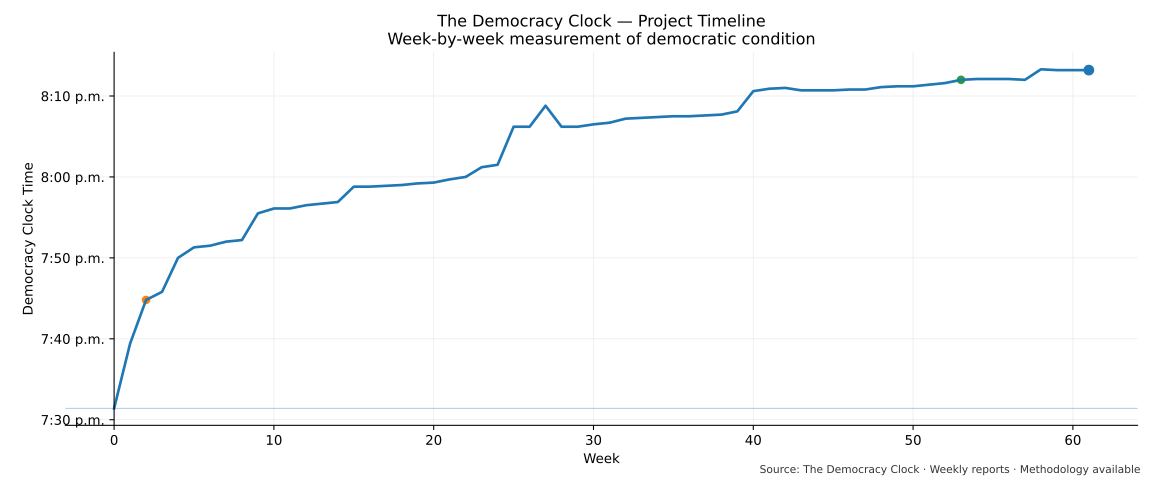
An unauthorized Iran war, weaponized immigration and voting rules, and curated secrecy deepen executive impunity while courts and civil society fight rearguard actions.
The sixty-first week of Trump’s second term was a week of consolidation rather than sharp turn. The pattern was not new: war abroad, pressure at home, and a steady narrowing of who counts and who decides. What changed was the density. Iran, immigration, elections, and information policy all moved at once, and the same hands appeared behind each lever. The result was not a single rupture but a thicker web of practices that made unchecked authority feel more routine and stratified citizenship more explicit. It felt less like a break than a tightening.
At the close of the previous period, the Democracy Clock stood at 8:13 p.m. By the end of this week, it remained at 8:13 p.m., a net shift of zero minutes. The stillness in the measure did not mean nothing happened. It meant that the week’s actions deepened patterns already in place rather than opening new fronts. Executive power, emergency governance, and information control all advanced, but along grooves cut in earlier weeks. Courts and civil society registered some resistance, enough to keep the clock from moving forward, not enough to push it back. The direction held steady, even as the path grew more worn.
The Iran war remained the central stage on which executive power was exercised and tested. Trump ordered a large-scale bombardment of Iran without new congressional authorization, treating prior resolutions and his own reading of commander-in-chief powers as sufficient warrant. Defense Secretary Pete Hegseth’s “no quarter, no mercy” rhetoric around the campaign signaled a willingness to push against the laws of war, not as a rogue statement but as part of the administration’s public posture. Together, the order and the language widened the zone in which lethal force could be used with little expectation of external review. War became a field for both violence and precedent.
Around that core, the presidency asserted unilateral authority in other domains that traditionally involve shared power. Trump claimed an “absolute right” to impose tariffs despite a Supreme Court ruling that had just struck down his earlier duties, and he asserted that he alone could withdraw the United States from NATO, notwithstanding statutory limits. These statements were not idle boasts. Within days of the Court’s decision, the White House reimposed broad temporary tariffs under a different statute, illustrating how the executive could pivot among legal hooks to preserve contested powers. The message to other branches was clear. Judicial and legislative constraints would be treated as obstacles to route around, not boundaries to respect.
The Iran conflict also served as justification for emergency moves that reached deep into domestic policy. Invoking the Defense Production Act, Trump ordered the reopening of a long-closed, spill-prone California oil pipeline over state objections, citing wartime energy needs. At the same time, reporting showed that the administration had earlier decommissioned the last U.S. mine countermeasure ships in Bahrain without reliable replacements, weakening the country’s ability to keep the Strait of Hormuz open. Planning failures helped create the crisis; emergency authority then supplied the remedy, overriding environmental safeguards and state autonomy in the process. War thus became both the cause of disruption and the rationale for sweeping executive fixes.
Congress, in theory the primary check on such moves, largely stood aside. The Senate rejected a resolution to limit Trump’s war powers against Iran, leaving his de facto authority to continue and expand operations intact. Congressional leaders held no substantive public hearings on the costs, strategy, or endgame of the war, even as Defense Secretary Hegseth requested more than $200 billion to fund expanded operations. At the same time, a partisan standoff over immigration enforcement left the Department of Homeland Security unfunded for weeks, disrupting TSA pay and airport security. The legislature proved capable of brinkmanship over domestic enforcement priorities but unwilling to assert its constitutional role over war and emergency powers. Performance displaced deliberation.
Intelligence oversight did not fill the gap. At a worldwide threats hearing, Director of National Intelligence Tulsi Gabbard and other chiefs gave evasive answers about Iran and Russian intelligence-sharing, carefully avoiding direct contradiction of the president’s narrative. The formal ritual of testimony proceeded, but the substance was thin. Combined with FBI leadership purges under Director Kash Patel and the sidelining of State Department energy sanctions staff, the hearing underscored how security institutions were being reshaped to align with the White House’s political needs rather than to inform Congress candidly. The machinery of oversight turned, but with less grip.
If the battlefield was one front of the Iran war, the information sphere was another. Trump used social media to boast that the United States was “totally destroying” Iran’s military and to attack critical outlets as unpatriotic. On Air Force One, he publicly berated an ABC News reporter, shushed her, and then cut off questions from the network, turning access to presidential information into a reward for deference. These gestures were not just personal pique. They signaled to the press corps that skeptical coverage could mean exclusion from the central stage of wartime reporting. Access became a lever of discipline.
Regulatory power was brought to bear as well. FCC Chair Brendan Carr warned that broadcasters could lose their licenses for “hoaxes and news distortions” about the war, a message Trump amplified and praised. The standard for what counted as distortion was left vague, but the threat was concrete: critical coverage might be framed as a violation of licensing obligations. In parallel, Trump accused mainstream outlets of wanting the United States to lose the war, casting dissenting narratives as disloyal. Together, the bully pulpit and the licensing regime were turned into tools to discipline independent media. The cost of skepticism rose.
Behind the scenes, intelligence and economic narratives were curated to support the same line. Gabbard’s written testimony to Congress omitted a sentence acknowledging that Iran had no nuclear enrichment capability after U.S. strikes, undercutting the administration’s claim of an imminent nuclear threat. White House economic officials downplayed the war’s impact on U.S. consumers despite clear evidence of rising fuel prices and looming jet fuel shortages. Investigative outlets documented planning failures around the Strait of Hormuz, including the lack of tanker escorts and the retired minesweepers, but those accounts competed with coordinated messaging that insisted the Strait was open and the economy unharmed. The administration’s PAC even used dignified transfer imagery and promises of private national security briefings to raise money, monetizing both sacrifice and insider information. Public tragedy became a fundraising asset.
In this environment, the stakes of secure communication and independent verification grew. Patel acknowledged that the FBI was buying Americans’ location data from commercial brokers without warrants, exploiting a loophole in Fourth Amendment protections. He also warned that Russian intelligence was hacking accounts on encrypted messaging apps, threatening the privacy of officials, journalists, and activists alike. DHS, for its part, invested heavily in AI-based surveillance partnerships, expanding algorithmic monitoring tools that could be repurposed for broad population tracking. Research showing that AI fact-checking systems could nudge users toward more accurate beliefs offered a small countercurrent. The dominant trend, however, was toward greater state and foreign capacity to watch, and to shape, what people see and say.
Immigration enforcement provided a different but related laboratory for how law and power could be used. In Miami-Dade, the sheriff’s office tripled the number of deputies deputized under the 287(g) program, integrating federal immigration checks into routine policing. Across the country, ICE and DHS wrongfully detained and deported asylum seekers and TPS holders in defiance of legal protections and settlements. Court filings described an Ecuadorian asylum seeker held unlawfully, Yemen TPS termination challenged as discriminatory, and asylum denials that ignored prior agreements. These were not isolated mistakes. They reflected an enforcement culture in which due-process norms were treated as obstacles to be worked around.
The human cost was stark. A 19-year-old detainee, Royer Perez-Jimenez, died in ICE custody, apparently by suicide, raising questions about mental health safeguards and accountability for deaths behind bars. Parents were deported to Honduras without being asked about their children, in violation of the administration’s own Detained Parents Directive, reviving the trauma of family separation. Activists, students, and families were held for prolonged periods under harsh conditions: a pro-Palestinian activist detained for a year, a Canadian mother and her autistic child with valid papers swept into detention, a journalist and other students caught up in enforcement actions. Immigration tools were being used not only to police borders but to punish vulnerability and dissent. Citizenship became a sliding scale of security.
Legal challenges emerged, but they were scattered and slow. New suits in Ohio, New Jersey, and Minnesota alleged unlawful warrantless ICE arrests, improper siting of detention facilities, and restrictions on clergy access. A New Jersey congresswoman introduced a bill to bar federal funds for immigration enforcement within a mile of World Cup venues, seeking to create a buffer against high-profile raids. Courts ordered releases in some cases and scrutinized TPS and asylum decisions. Yet the daily discretion of ICE officers and local partners remained vast, and the pattern of wrongful detention and deportation continued. Law on the books and law in practice diverged.
Beyond immigration, protest itself came under sharper criminal and physical pressure. In New York, federal prosecutors charged two teenagers with terrorism offenses for throwing explosive devices during a protest near the mayor’s home, framing protest-adjacent violence as terrorism with decades-long penalties. In California, the Justice Department brought a federal conspiracy case against veteran Bajun Mavalwalla for blocking ICE vans during a demonstration, using heavy charges to deter direct action. In Los Angeles, a protester at an anti-ICE rally was allegedly blinded by a projectile, in violation of a court order on “less-lethal” munitions, prompting a $100 million claim. These cases showed how the line between protest and security threat was being redrawn in ways that raised the cost of dissent. The streets grew riskier.
Universities became a central battleground. The administration filed a civil-rights lawsuit against Harvard, accusing it of violating Jewish and Israeli students’ rights by allowing anti-Israel protests. The suit leveraged Title VI funding threats against a major university, effectively warning that tolerating certain forms of political speech could jeopardize billions in federal support. At the same time, federal courts issued rulings affirming that common pro-Palestinian campus speech was constitutionally protected and rejecting some antisemitism claims against universities. Grassroots groups organized medic trainings, “No Kings” town halls, and weekly anti-ICE protests, building capacity for nonviolent resistance. The result was a contested space in which protest culture persisted but under growing legal and financial strain.
While the streets and campuses were being policed, the architecture of voting was being quietly reshaped. In the Senate, a cloture vote advanced debate on the SAVE America Act, which would require documentary proof of citizenship to register to vote. In North Carolina, the state board of elections proposed rules enabling challenges to registered voters’ citizenship status, mirroring the SAVE Act’s logic at the state level. The Justice Department launched lawsuits and data demands aimed at voter-roll maintenance, pressing states for detailed voter information under the banner of list accuracy. Analyses by Democracy Docket and others explained how these moves, framed as “election integrity,” could lead to aggressive purges and targeted challenges that disproportionately remove eligible voters, especially immigrants and minorities. The language of fraud masked a shift in who bears the burden.
Taken together, these measures formed a single architecture. Federal law would raise documentation barriers; state rules would invite challenges to citizenship; DOJ actions would pressure states to scrub rolls more aggressively. Each step could be defended as technical or neutral. In combination, they shifted the burden of proof onto individual voters and made participation more precarious for those without ready access to paperwork or legal support. The right to vote remained on paper, but the path to exercising it narrowed. Integrity became a gate, not a guardrail.
Transparency and accountability, which might have checked these trends, were themselves under strain. Congress passed the bipartisan Epstein Files Transparency Act, requiring the Justice Department to disclose investigative records on Jeffrey Epstein. But DOJ missed statutory deadlines and, according to reports, released files from which pages of Trump-related interviews had been removed. A 69-page money-laundering memo was blocked from release. Senator Ron Wyden demanded unredacted DEA documents, accused Deputy Attorney General Todd Blanche of obstruction, and introduced legislation to force Treasury to turn over Epstein-related financial records. The House Oversight Committee subpoenaed Attorney General Pam Bondi for sworn testimony on the handling of the files. The law existed; compliance lagged.
These oversight efforts met a justice system that seemed determined to protect certain networks. Whistleblowers described attempts to withhold unclassified but sensitive Epstein and DEA records from Congress. Environmental groups sued Energy Secretary Chris Wright and the Archivist under the Federal Records Act, alleging that DOE officials had used personal email for climate rulemaking without proper archiving. In a separate case, a former employee of a state Department of Government Efficiency was accused of taking databases containing Social Security numbers to share with a contractor. The pattern was consistent. Politically sensitive records were mishandled, delayed, or curated, while vast stores of ordinary citizens’ data were moved and used with little regard for privacy.
Inside law enforcement, personnel changes reinforced the same direction. Under FBI Director Kash Patel, senior counterintelligence executives were pushed out, and two agents who were fired filed suit alleging political retaliation. These purges, combined with Patel’s embrace of warrantless data purchases, signaled that internal dissent and professional counterintelligence priorities were being subordinated to loyalty and flexibility. Inspectors general and other watchdog functions were not formally abolished, but their influence was eroded by leadership choices and the sidelining of those who raised concerns. The guardrails bent under pressure.
Against this backdrop, courts emerged as one of the few arenas where formal limits on executive power still held. Judges in Massachusetts and Oregon blocked RFK Jr.’s attempts to overhaul vaccine schedules and to declare gender-affirming care unsafe for youth, enforcing procedural law and preserving access to established medical standards. In Washington, Judge Royce Lamberth issued summary judgments and reinstatement orders for more than 1,000 Voice of America staff, reversing Kari Lake’s unlawful restructuring of the U.S. Agency for Global Media and defending statutory safeguards for an independent public broadcaster. The Supreme Court’s ruling that Trump’s 2025 import tariffs exceeded statutory authority reasserted judicial control over emergency economic powers. The courts, for now, could still draw lines.
These decisions did not go unanswered. Trump responded to the tariff ruling by reimposing duties under a different statute and by insisting he had an “absolute right” to set tariffs, casting the Court’s decision as an illegitimate intrusion. He renewed personal attacks on Judge James Boasberg after adverse rulings, calling for his discipline or removal and signaling to the broader bench that independence carried political risk. RFK Jr., for his part, reshaped the Interagency Autism Coordinating Committee, removing autistic representation and adding anti-vaccine activists, politicizing a key science advisory body even as his broader policy moves were struck down. The courts could still say no, but the administration was working to change who would be in the room the next time.
Economic policy tied many of these strands together. Iranian attacks on shipping and effective closure or control of the Strait of Hormuz drove oil prices and freight costs sharply higher, exposing how quickly geopolitical conflict could strain household budgets. The administration responded by temporarily lifting sanctions on Russian oil despite the ongoing war in Ukraine and by considering the removal of sanctions on Iranian oil even as strikes hit Iranian energy infrastructure. Sanctions became tools for managing markets as much as for coercing adversaries. At home, airlines warned of jet fuel shortages and potential flight cancellations, wholesale inflation remained elevated, and the national debt climbed past $39 trillion, with war spending a significant driver. The costs spread outward.
Within this landscape, elite actors used their resources to shape outcomes. Jared Kushner, serving as Special Envoy for Peace, sought $5 billion from Saudi, Qatari, and Emirati sovereign funds for his private equity firm, blurring the line between diplomacy and personal enrichment. Sergey Brin and allied tech billionaires poured tens of millions into blocking a California wealth-tax initiative aimed at funding education and social programs, while other donors used large contributions to influence the state’s ballot process. Republicans in Congress struggled to assemble funding for the Iran war even as Defense Secretary Hegseth requested hundreds of billions, highlighting the tension between open-ended military aims and a tax system structured to protect concentrated wealth. Inequality was not incidental; it was built into the choices.
Domestically, the same logic of control and precarity appeared in labor and criminal justice. California prosecutors filed nearly 20,000 felony drug-possession cases under Proposition 36, emphasizing incarceration over promised treatment and showing racial disparities in enforcement. Former USAID officers sued over a reduction in force they alleged targeted older foreign service staff, suggesting that workforce restructuring was being used to sideline experienced employees and weaken protections for older workers. These moves eroded labor security and deepened inequality, making workers more dependent and less able to challenge policy choices that harmed them. Vulnerability became a management tool.
Surveillance and memory formed the final layer of the week’s pattern. DHS’s AI projects and the FBI’s data-broker purchases expanded the state’s ability to monitor ordinary people, while the Epstein files saga, DOE email practices, and the Cesar Chavez Day cancellation in Arizona showed how official records and commemorations could be altered or withheld. Arizona’s decision to drop Cesar Chavez Day as a state holiday after posthumous abuse allegations illustrated how public memory of labor and civil-rights figures could be reshaped quickly, with little process, in ways that affected how future generations understood past struggles. In the Epstein context, selective disclosure and redaction did something similar for elite misconduct, ensuring that what could not be controlled might simply be erased. Memory itself became contested ground.
No single scheduled event in this week promised a clean resolution. The Senate’s debate on the SAVE Act, ongoing litigation over Epstein records, and pending suits on immigration detention and climate rollbacks all pointed toward future confrontations, but their outcomes remained uncertain. What was clear was that courts, state coalitions, and advocacy groups had become central arenas for contesting federal power, even as those arenas themselves were being pressured and reshaped. The fights moved to venues that were also under strain.
In the arc of Trump’s second term, this week marked a deepening of existing grooves rather than a new departure. War was used to justify emergency authority and to mask planning failures. Immigration and protest were treated as security problems to be managed with harsh tools. Voting access was narrowed through technocratic rules framed as integrity. Transparency laws were passed and then blunted in implementation. Courts pushed back in key areas, but their independence was challenged by rhetoric, appointments, and structural changes to advisory bodies. Surveillance expanded, and the historical record was curated. The Democracy Clock did not move because the week did not change the direction of travel; it made that direction more entrenched, and more costly to reverse.