Week 60: Consolidation by War and Ballot
March 7 - 13, 2026
Week Sart Time:8:13 p.m.
Week End Time:8:13 p.m.
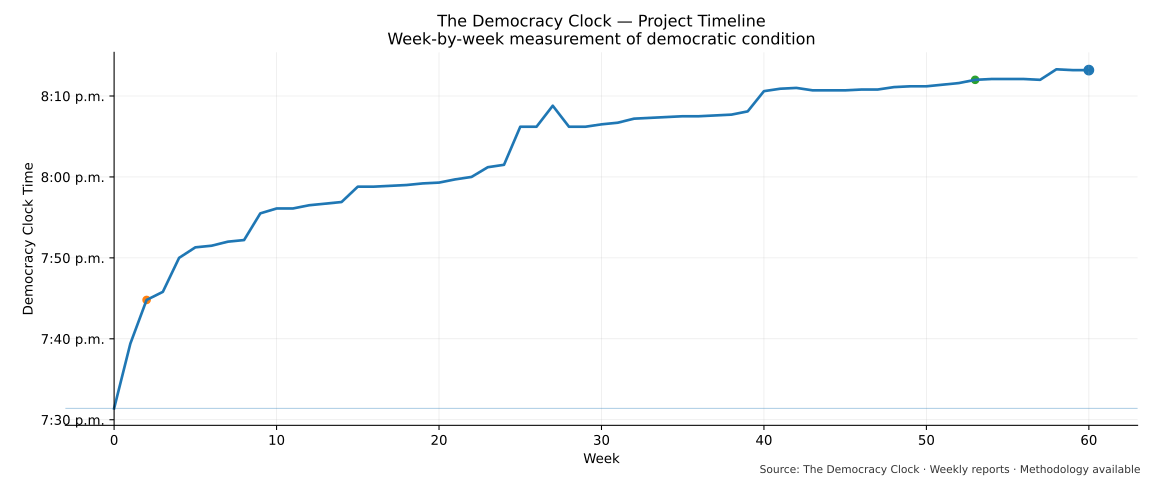
A week of steady, coordinated erosion in which war powers, voting rules, and captured bureaucracies tightened executive control without a single dramatic break.
The sixtieth week of Trump’s second term did not bring a new shock so much as a sharpening of an existing pattern. War abroad, voting rules at home, and the quiet redirection of bureaucracies all moved in tandem. Each domain had its own language—national security, election integrity, fiscal responsibility—but the underlying motion was the same: more power in fewer hands, more risk pushed downward, and more distance between public decisions and public consent. The surface remained busy and fragmented. The structure beneath grew more coherent.
At the close of the previous period, the Democracy Clock stood at 8:13 p.m. By the end of this week, it remained at 8:13 p.m., a net change of zero minutes. The stillness in the measure did not reflect a pause in activity. It reflected a week in which many traits of democratic erosion worsened together without a single, discrete rupture large enough to move the hand. War powers, voting access, regulatory capture, and information control all deepened along paths already set. The system did not fall further in a sudden drop. It settled more firmly into its new shape.
On the battlefield, that shape took the form of Operation Epic Fury, the joint US–Israel air campaign against Iran. The operation’s stated aims shifted as the week went on: degrading air defenses, forcing Iran to the table, ending “terrorism at its source.” What did not shift was the tempo of strikes. US aircraft and missiles hit targets across Iran, from air bases to suspected command centers. Officials spoke of precision and restraint. The scale told a different story. The Pentagon acknowledged billions in munitions expended in less than a week, and the sorties continued.
The costs of Epic Fury were not confined to military hardware. Reports emerged of an airstrike that hit a school, killing and injuring children. Inside the administration, investigators concluded that US targeting decisions had contributed to the error. Publicly, Trump denied responsibility and cast blame on Iranian tactics. The gap between internal findings and external statements widened. At the same time, the Navy and Air Force absorbed their own losses: a submarine damaged or lost under disputed circumstances, aircraft downed in contested airspace. Each incident added to a ledger of risk that the public could not fully see.
Iran responded in ways that turned a bilateral conflict into a regional crisis. Mines appeared in and near the Strait of Hormuz, disrupting one of the world’s key oil chokepoints. Tankers reported damage. Insurance rates spiked. Iranian missiles and drones struck targets in the Gulf, including near Dubai and other commercial hubs. The strikes were limited but symbolic. They showed that Iran could reach the financial centers that underpinned the global economy. The war’s geography expanded from Iranian soil to the shipping lanes and cities that connect Asia, Europe, and the United States.
The US answer to this escalation was more force. Additional troops and assets were deployed to the region, including air defense units and naval escorts. Officials described these moves as protective and temporary. Yet the logic of reinforcement was open-ended. Each new threat justified another layer of presence. Each new deployment created more targets and more potential flashpoints. The line between deterrence and entanglement blurred. The war that had been sold as a sharp, decisive blow began to look like a rolling commitment with no clear end.
As the conflict widened, the administration’s rhetoric grew more chaotic. On some days, Trump declared that Iran was “on its knees” and that victory was near. On others, he warned of a long struggle and demanded unconditional surrender. Senior officials floated timelines for drawdown, then hinted at further escalation. Statements about objectives—regime behavior, nuclear capacity, regional influence—shifted from interview to interview. At the same time, the Pentagon touted the use of advanced artificial intelligence systems to select and assess targets, presenting automation as a way to speed decisions and reduce risk. The combination of algorithmic warfare and unstable political messaging created a sense that the machinery of conflict was running ahead of any settled strategy.
In Washington, Congress had its own war story, and it ran parallel to the one in the skies over Iran. Efforts to reassert legislative control over the conflict faltered. In both chambers, resolutions aimed at limiting Trump’s authority to wage war on Iran were blocked or defeated. Democratic attempts to tie funding to clearer objectives or to sunset clauses failed to gain enough Republican support. Leaders in the majority framed these moves as distractions or as gifts to the enemy. The constitutional power to declare war and oversee its conduct remained on paper. In practice, it was set aside.
The administration, meanwhile, leaned on emergency authorities to bypass Congress on both funding and arms sales. Trump invoked emergency powers to move money into the Iran campaign without normal appropriations and to push through a major bomb sale to Israel that would feed back into the operation. The Pentagon briefed lawmakers that $11.3 billion had been spent in six days, with talk of another $50 billion request on the horizon. Some Republicans grumbled privately about the scale and the impact on domestic programs. Publicly, they voted to keep the money flowing. The theoretical power of the purse became a talking point rather than a constraint.
Trump’s own framing of the war’s economic fallout underscored the gap between executive rhetoric and congressional responsibility. As oil prices rose and markets reacted to the Hormuz disruptions, he described the spikes as a “small price to pay” for American strength and victory. The phrase captured the asymmetry at work. For households facing higher fuel and food costs, the price was not small. For the White House, the costs were abstracted into a story of resolve. Congress, which might once have translated those costs into political pressure, instead absorbed them.
If war was one front in the week’s consolidation of power, voting rules were another. In the House, Republicans pushed through the SAVE or Save America Act, a sweeping bill that rewrote the terms of access to the ballot. The legislation required strict proof of citizenship and new forms of identification for registration and voting, measures that experts warned would fall hardest on women who had changed names, on naturalized citizens, and on low-income voters without ready access to documents. Supporters framed the bill as a defense of election integrity. Its design pointed toward mass disenfranchisement.
Trump did not leave passage to persuasion alone. He issued an ultimatum: no other legislation would move, including routine appropriations and bipartisan priorities, unless the Senate passed the SAVE Act and sent it to his desk. He threatened Republican senators with primary challenges and public shaming if they wavered. The White House floated the idea of cutting funding for the Justice Department’s Voting Rights Act enforcement programs, signaling that federal civil-rights lawyers who had long monitored discrimination at the polls might soon be sidelined. The message was blunt. The price of governing was agreement to narrow the electorate.
At the state level, parallel maneuvers unfolded. In Utah, Republican officials advanced a rule that blocked voters from withdrawing their signatures from a petition to repeal an anti-gerrymandering reform, even as that petition moved forward. The rule change, rushed through, made it harder for citizens to correct course if they felt misled. At the same time, the legislature moved to expand the state supreme court, adding seats in a way that would allow the ruling party to shape the bench for years. A lower court refused to block a fairer legislative map that had emerged from earlier litigation, but the structural tilt of the judiciary was being adjusted for the long term.
The Justice Department and allied agencies kept the past alive as a tool in the present. New subpoenas and investigations into the 2020 election focused on Arizona and other battlegrounds, despite the certification of those results years earlier. Immigration and Customs Enforcement joined in, seeking data on noncitizen voting that state officials in red jurisdictions refused to share with the federal government. The effect was to keep doubts about prior outcomes simmering while building a case for tighter rules now. Under the banner of integrity, the ground rules of representation were being rewritten.
While ballots and districts were being contested, the machinery of security and immigration was being repurposed. Inside the Department of Homeland Security, civil-rights and detention-oversight offices were gutted. Staff were cut, mandates narrowed, and complaint channels shifted to English-only formats that many detainees and affected communities could not use. Internal watchdogs were described in official documents as “internal adversaries,” a phrase that recast oversight as disloyalty. The capacity to investigate abuse and vindicate rights shrank, not by statute but by attrition and redefinition.
On the ground, ICE and allied agencies launched operations that targeted specific communities. In Ohio, Operation Buckeye focused on Somali Americans, with raids and arrests that spread fear far beyond the individuals charged. Nationwide, a crackdown on immigrant truck drivers disrupted livelihoods and supply chains, justified by vague references to security and fraud. In Ohio again, lawmakers proposed mandatory cameras in all state-funded childcare centers, a measure that arose amid suspicion directed at Somali-run facilities. Surveillance and enforcement were concentrated where political rhetoric had already marked people as suspect.
The language of terrorism and extremism was applied unevenly. In Texas, anti-ICE protesters were convicted under state anti-terror laws, their civil disobedience recast as a security threat. A senator physically manhandled a protester at a hearing, an act that signaled how dissent could be met with force rather than argument. In another case, ISIS-inspired teenagers who planted improvised explosive devices at anti-Islam protests targeting a Muslim mayor were prosecuted, but the broader climate included tolerated Islamophobic rhetoric from national leaders. When a shooting at Old Dominion University was framed as terrorism, it fit a pattern in which the label attached more readily to some forms of disruption than others, often in ways that aligned with regime narratives.
Courts did not vanish from this landscape. In Oregon and Minnesota, judges pushed back against ICE abuses, granting habeas relief and curbing unlawful detentions. These rulings showed that legal tools for resistance remained. Yet they were exceptions set against a broader trend in which security institutions defined their own priorities and hollowed out their own checks. The line between law enforcement and political repression grew thinner, even as it remained formally intact.
Control over information about these developments became a battleground of its own. The administration released stylized propaganda videos of the Iran war, with gamified combat footage aimed at specific demographics. Trump used social media to claim that Iran had already surrendered, statements that bore little relation to the facts on the ground. At the same time, a multi-agency threat bulletin on Iran-related risks to the homeland was blocked from reaching state and local authorities. The flow of intelligence was managed not only for security but for narrative effect.
Confusion was not an accident. A disputed Navy tweet about escorting commercial vessels through Hormuz was posted and then walked back, leaving allies and markets uncertain about US commitments. The FBI circulated an unverified alert about hostile unmanned aerial vehicles that sowed alarm without clear grounding. Casualty figures from the Iran campaign were underreported, then revised upward after pressure from lawmakers who had been briefed privately on higher numbers. When a school strike killed children, internal findings pointed to US responsibility, but Trump publicly denied any fault. Each episode chipped away at the idea that official statements could be trusted as a baseline.
The Pentagon tightened its grip on imagery as well. Defense Secretary Pete Hegseth banned photographers from Iran-war briefings after complaining about “unflattering” images, a move that limited the visual record of the conflict. He also attacked CNN’s coverage, suggesting that it would improve once the network came under friendlier ownership. The message to journalists was clear: critical reporting on the war would be met with both access restrictions and public smears. Independent media, already under financial strain, faced new pressure from the very institutions they were trying to scrutinize.
Beyond war, the Justice Department’s handling of documents related to alleged sexual assault by Trump in the Epstein network illustrated how archives themselves could be curated. Under a transparency statute, DOJ released some materials but withheld 37 pages without clear explanation. The partial disclosure created the appearance of openness while keeping key details out of public view. In the same week, courts voided Kari Lake’s actions at the US Agency for Global Media because her appointment had been unlawful, and judges rebuked politicized appointments in a state attorney general’s office. These rulings showed that legal norms around appointments and separation of powers still had force. Yet the broader pattern was one in which the executive tested boundaries and the public record was shaped to minimize exposure.
On the domestic policy front, the One Big Beautiful Bill Act marked a major shift in the social contract. The law imposed deep cuts on Medicaid and other public health programs, reducing access to care for millions. It did so at a moment when war spending was surging, making the tradeoff stark. The bill also advanced the privatization of health services, pushing people toward markets and out-of-pocket costs. Workers’ bargaining power weakened as healthcare became more precarious and more tied to employment or personal wealth. The state’s role as a guarantor of basic security shrank.
Environmental and chemical regulation moved in the same direction. The Environmental Protection Agency repealed the greenhouse-gas endangerment finding, a cornerstone of federal climate policy that had underpinned limits on emissions. In Congress, a Republican-led farm bill granted pesticide manufacturers delayed safety reviews, liability shields, and influence over safeguards. Air-pollution rules were rolled back, even as technocratic actions like new emission standards and water advisory structures continued in other corners of the bureaucracy. The contrast showed a split state: parts still operating on professional norms, others captured by industry.
The relationship between regulators and corporate litigants came into sharp relief in the case of Bayer. EPA leadership met closely with the company before the administration backed Bayer’s position in a Supreme Court case, aligning the government’s legal stance with a major chemical producer’s interests. At the Food and Drug Administration, more than a hundred food substances deemed “generally recognized as safe” had never received formal review, leaving entire sectors shielded from scrutiny. These patterns, combined with the war-driven cuts to domestic programs and the Pentagon’s continued luxury spending, shifted risk and cost onto the poor and sick while protecting corporate balance sheets.
Overlaying all of this was a web of crony capitalism and elite money that shaped both foreign and domestic policy. Jared Kushner, still receiving large payments from Gulf governments, played a role in advocating for the Iran attack. At the same time, the administration advanced a $142 billion arms package to Saudi Arabia, deepening ties between US defense contractors and a repressive monarchy. To cushion domestic economic fallout from the Iran war, the White House eased and then broadened sanctions on Russian oil, channeling windfalls to an authoritarian power whose interests aligned with Trump’s political needs. Foreign influence was not merely tolerated. It was welcomed when it served regime goals.
At home, new data showed that billionaires dominated federal campaign finance. Figures like Elon Musk and Vivek Ramaswamy poured money into races and causes, while Trump promised to extend the 2017 tax cuts that had favored corporations and the wealthy. In California, Silicon Valley money flooded the campaign to defeat a Billionaire Tax Act, ensuring that progressive tax reforms faced not only political opposition but overwhelming financial firepower. Consumer lawsuits over tariff refunds revealed another layer, as companies retained surcharges collected under illegal tariffs even after courts ordered refunds, turning unlawful policy into profit channels for firms close to power.
The judiciary sat at the intersection of these currents. On one side, courts struck down Trump’s tariffs as unconstitutional, and the trade court ordered refunds and halted further collection. Judges voided Kari Lake’s actions at the US Agency for Global Media because she had not been lawfully appointed, and they blocked politicized appointments in New Jersey’s attorney general’s office. Immigration habeas cases in Oregon and Minnesota produced rulings that checked ICE abuses. These decisions affirmed that some boundaries still held, and that legal arguments could still prevail against executive overreach.
On the other side, law was used as a weapon against dissent and as a tool for partisan entrenchment. Texas prosecutors secured terrorism convictions against anti-ICE protesters, and a plea deal in the “Cop City” protest case underscored how broad charges could be used to chill activism. Senator Tim Sheehy’s physical handling of a protester at a hearing signaled a willingness to meet opposition with force rather than debate. In Utah, the expansion of the state supreme court and the ongoing map litigation showed how judicial structures themselves could be reshaped to favor the ruling party. The same institution that could check power in one case could be bent to serve it in another.
No single hearing, vote, or strike defined Week 60. Its significance lay in the way these strands wove together. War provided the pretext for emergency spending, information control, and foreign entanglements that enriched allies and donors. Voting rules and court structures were adjusted to lock in advantage at home. Security and immigration agencies turned inward, targeting communities marked as suspect while dismantling their own oversight. Health and environmental protections were rolled back in ways that shifted burdens onto those least able to bear them. Money and media continued to tilt elections toward elite outcomes, even as the formal rituals of democracy persisted.
The Democracy Clock did not move because these changes did not alter the basic category of risk so much as deepen it. The week marked consolidation rather than rupture. The methods that had once seemed extraordinary—emergency rule, voter suppression framed as integrity, law as a weapon, chaos as strategy—were applied with greater confidence and less resistance. Institutions still functioned. Courts still issued mixed rulings. Journalists still reported, and some judges still pushed back. But the cost of using those channels rose, and the distance between formal rights and lived power widened.
In that sense, Week 60 belongs to the long arc of normalization. It shows how a democracy can remain outwardly intact while its core practices are bent toward the service of war, wealth, and personal rule. The erosion did not announce itself. It continued, steady and quiet, in the spaces where law, policy, and narrative meet.