The Democracy Clock
Week 71: Personal Rule Through State Power
How the Democracy Clock Works
A cumulative measure of democratic erosion and repair in the United States, grounded in verified events, structural traits, and a locked archival methodology.
What the Clock Measures
The clock does not track opinion, sentiment, or prediction. It records what has happened, based on verified events, institutional action, and structural change.
Each movement of the clock reflects concrete developments affecting the rule of law, civil rights, electoral integrity, governance, information, and the balance of power. Advances toward midnight indicate democratic damage; movement back toward noon reflects meaningful repair. The clock does not reset. It only moves forward and backward based on verified events.
How Time Moves
Time on the Democracy Clock moves only when events justify it. Movement is derived from documented actions by government actors, courts, agencies, and other institutions with democratic consequence, evaluated in context rather than isolation.
There is no fixed quota, no artificial balance, and no narrative smoothing. Some weeks move the clock sharply; others barely at all. Courts, civil society, and institutional resistance can slow or reverse damage—but only when their impact is real and durable.
How to Read the Clock
The clock uses time—from noon to midnight—as a continuous scale to represent the condition of democratic self-government. Noon represents the strongest achievable alignment between democratic institutions and democratic outcomes. Midnight represents systemic democratic failure.
Time is used instead of grades, scores, or rankings because democratic erosion rarely occurs in discrete steps. Time allows the record to show direction, pace, and persistence without forcing false precision.
Certain ranges on the clock are associated with recurring historical patterns—periods of institutional stress, democratic fragility, or authoritarian consolidation. These thresholds are descriptive, not predictive. They do not trigger alarms or forecasts; they provide historical context for interpreting movement.
Why This Record Exists
Democracies rarely collapse in a single moment. They erode through accumulation: precedent by precedent, norm by norm, power shift by power shift. The Democracy Clock exists to make that accumulation visible.
This project is a public record—locked, archived, and methodologically consistent—so that erosion cannot be minimized, normalized, or rewritten after the fact. It is designed for citizens, journalists, scholars, and future readers who want to understand not just what happened, but when, how, and at what cost.
What Is Measured
The Democracy Clock records what has happened, week by week, based on verified events, institutional actions, and structural change.
Each entry reflects concrete developments affecting the rule of law, civil rights, electoral integrity, governance, information, and the balance of power.
How It Is Measured
Weekly movement is derived from a locked, archival process: events are documented, mapped to recurring democratic traits, and translated into cumulative time.
Each week is evaluated in context, not isolation, and once recorded, entries are not silently altered..
What It Is Not
This is not opinion, prediction, or commentary, and it does not forecast outcomes or assign blame.
Time moves only when verified actions change the democratic balance of power.
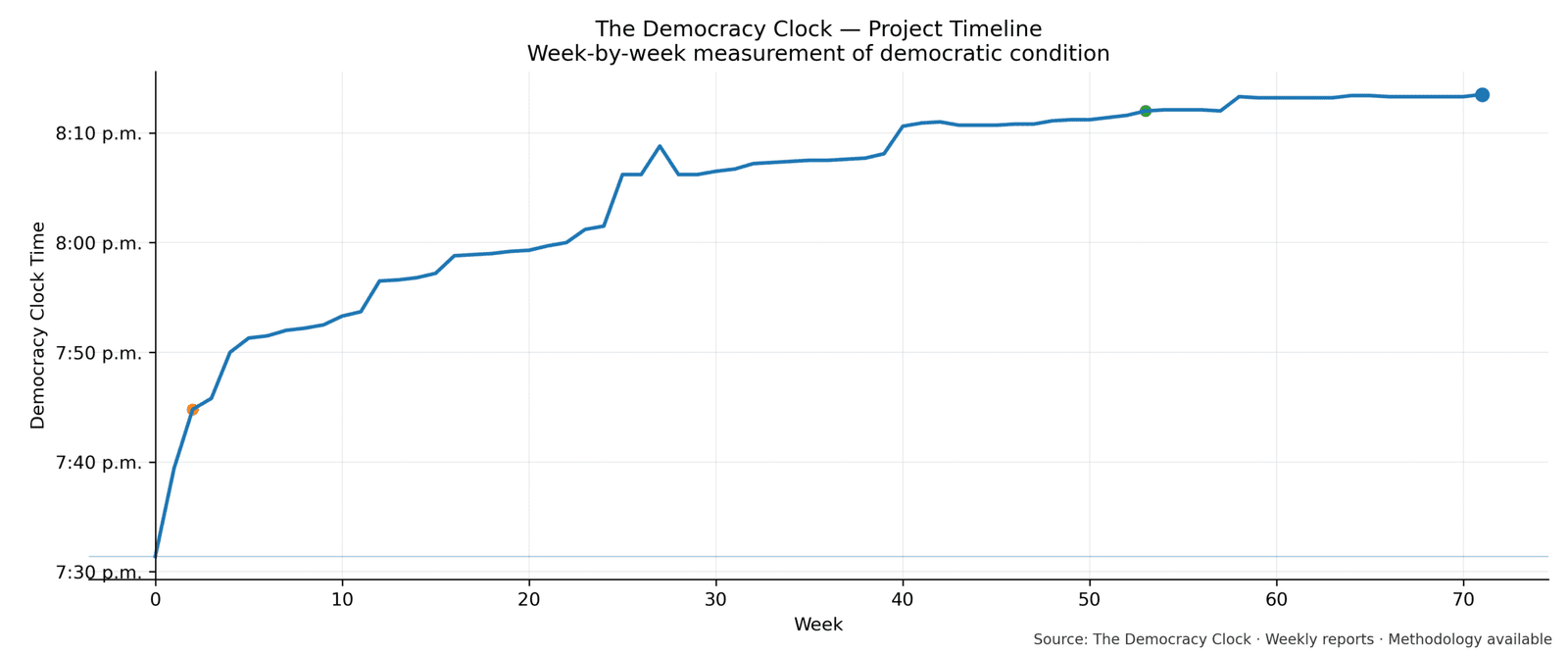
The Democracy Clock Over Time
The Democracy Clock moves cumulatively, not episodically. Each week’s movement reflects the accumulation of decisions, precedents, and institutional shifts that either strengthen or weaken democratic governance. The clock does not reset between crises, and it does not respond to headlines alone; it advances or retreats only as underlying conditions change over time.
The Diagnostic Framework
The Democracy Clock is anchored in a diagnostic framework of sixty structural traits used to assess democratic breakdown. These traits identify structural conditions that make democratic abuse easier, accountability weaker, and recovery harder. Each week’s events are evaluated against this framework to determine whether democratic time has been lost, preserved, or regained.
The Moral Floor
Democratic legitimacy rests on more than procedural legality. The Democracy Clock applies a moral floor—a civic covenant below which governance may remain lawful yet cease to be just. When basic obligations to dignity, equality, and restraint are breached, democratic time is lost even if formal processes continue to operate.